Categories

A sample text widget

Etiam pulvinar consectetur dolor sed malesuada. Ut convallis euismod dolor nec pretium. Nunc ut tristique massa.

Nam sodales mi vitae dolor ullamcorper et vulputate enim accumsan. Morbi orci magna, tincidunt vitae molestie nec, molestie at mi. Nulla nulla lorem, suscipit in posuere in, interdum non magna.

Comments on the Blog

Thank you for your comments and encouragement.   We’ve gotten so many comments of encouragement that it would block the “Posts” to post them all, when they only encourage and compliment (don’t get me wrong those are much appreciated).  We will however post all content related to the topic of Copper Nickel Sulfide Mining.  Also, we are still waiting for proof of the process and environmental safety of such mining.  So far no one has come forward to offer anything other than the promises and selling points directly from a less than stellar industry, those who would profit most from the extraction of Minnesota’s mineral resources.

Thanks again for your comments and please keep them coming.  Love to hear from you.

rw

Sulfide mining should have no place in Minnesota’s lake country

First posted on MPR News  by Christopher Loch   January 11, 2010

The media need to start telling the whole story about newly-proposed mining projects in Northern Minnesota. The public should know about how mines such as those proposed by the Canadian company PolyMet will affect the Boundary Waters Canoe Area Wilderness (BWCAW) and other natural areas and resources in Minnesota.

These mining projects are both economically toxic and environmentally unsound.

Environmental damage from such mining will be huge and irreversible. The type of mining currently being considered in Minnesota extracts precious metals like copper and gold at the expense of our precious waters and other natural resources.

Such Minnesota traditions as iron and taconite mining are totally different from the sulfide mining now under consideration. Sulfide mining has never been done in Minnesota before, and for all practical purposes is banned in neighboring Wisconsin due to pollution concerns.

Sulfide mining exposes sulfur-bearing soil and rocks to air and water, resulting in the formation of immense amounts of sulfuric acid. This in turn causes heavy metal and sulfuric acid pollution in the surrounding watershed (ground water, streams, rivers and lakes in the area, in this case including Lake Superior). There would be massive fish kills and dead bodies of water with no life in them at all, among other damage.

This is not hypothetical. It’s guaranteed. Everywhere that sulfide mining has been done it has resulted in irreversible environmental harm. Once the sulfur-rich soil and rock is disturbed, the process of leaching will begin, and it will continue essentially forever. Let me repeat: forever. Any attempt at cleanup would have to go on forever also, costing the taxpayers large sums of money in perpetuity.

Take for example the Asarco Mine in Butte, Mont. It is now an EPA superfund site that requires costly and perpetual water treatment due to sulfide mining. And there are many more examples. In fact, the EPA has reported that sulfide mining is the single largest source of toxic pollution in the United States.

Reputable scientists dispute claims by the sulfide mining industry that new technologies can contain or prevent the pollution caused by sulfide mines.

Meaningful cleanup of such pollution is impossible. We are dealing with a gigantic, porous chunk of the earth. Landfills and other pollution storage caches have all been shown to leak due to natural processes such as tremors, burrowing animals, plant roots, chemical reactions and more. So containment is out. And this kind of mess can never be “cleaned up” in any real sense. The law of diminishing returns promises that some hard to reach areas of pollution will be too expensive to clean up. Finally, implicit in the concept “cleaned up” is the idea of an end date at which the pollution will be gone. Perpetual water treatment is by definition never finished.

The cost of any perpetual pollution mitigation (however imperfect) would be astronomical. It is quite possible that in our new economic reality, politicians would not raise taxes to pay for the cleanup, and thus it would never be undertaken. And there is no reliable way to ensure the companies will be held accountable. Even if a law were passed to do so, that law would be unenforceable if the companies went bankrupt.

It’s happened before. Another Canadian company, Dakota Mining, filed for bankruptcy after a subsidiary created an environmental nightmare near Deadwood, S.D., in the 1990s. The state collected the bond that the firm had posted, but the amount was nowhere near enough to cover cleanup costs.

All this should be enough to stop debate and prevent any sulfide mining from ever happening here. But there is more to consider. Nine billion dollars is spent annually in Minnesota on lake-based tourism. That is a significant part of the state economy, and in some areas its contribution is crucial. Just ask Jane and Steve Koschak, who own a family resort on Birch Lake, where sulfide mining is proposed. They worry that tainted waters could harm their business. Already, noise from test drilling in the middle of the lake is affecting their previously quiet vacation area.

You can hear from the Koschaks and others living in areas that will be affected by the proposed sulfide mining in a short documentary called “Precious Waters” at www.preciouswaters.org. Residents there were at first largely supportive of precious metal mining, but they have turned against it after finding out that it’s not like iron mining.

What will happen to the Boundary Waters if this mining happens? If its pristine waters are tarnished by pollution, large numbers of tourists who come from all over the world to canoe there would likely stop coming. If the mining begins, not only chemical pollution but industrial noise pollution will find its way into the BWCAW. Even if expensive water treatment were undertaken (forever) to try to remedy the water pollution, it would be hard to sell the BWCAW as pristine given the mining noise and large industrial-looking water treatment facilities nearby.

Beyond the Boundary Waters, the wider lake-based tourism economy depends on tourists’ perception that Minnesota’s lakes are clean and healthy. If sulfide mining undercuts that perception, tourism near the mines will surely decrease. But I believe it will also affect tourism for lake areas in Minnesota that are nowhere near the BWCAW and mining sites.

Think about it. Have you ever decided not to vacation somewhere because of one single negative thing you heard about it? Non-Minnesotans don’t know much about our state. They know a few city names and a few amenities perhaps. They usually have no idea how far one place is from another. So major pollution of the cleanest waters in Minnesota will likely affect overall perceptions of all of Minnesota’s waters.

Additionally, if the many mines that are proposed go forward, “up north” will be scarred with monumental new piles of rubble and pot holes that are miles across and hundreds of feet deep where scenic natural beauty once was. Will that have an effect on tourism?

The lake-based tourism economy and the tens of thousands of jobs it generates dwarf any benefits that could possibly come from this un-Minnesotan type of mining.

Sulfide mining in Minnesota just doesn’t add up, economically or environmentally. Any amount of economic benefit will be short lived and shared by only a few. Whereas all Minnesotans will lose the pristine and majestic nature of the BWCAW and other precious waters up north. Instead of being compensated for that terrible loss, we will be paying taxes to do water treatment up there until kingdom come.

Ernest Oberholtzer and others saved our precious “up north” once before by preventing Edward Backus from building seven dams there. Those opposed to the dams included many farsighted businessmen. Now as then, the choice isn’t between serving business and protecting the environment. Many folks go up north and to the BWCAW with buddies they don’t necessarily agree with, politically or otherwise, but together they share the values that have kept these lakes among the cleanest in the world.

“Up north” can be saved again. It will take some hard work by citizens and some well researched and balanced coverage by the media. People should call their federal, state and local representatives, and tell them not to fall for the fallacy that sulfide mines will help the state economically. And they should remind the DNR that its job is to protect the natural resources of Minnesota, not auction them off.

Christopher Loch, Minneapolis, works as a printer and often vacations in the BWCAW.

Good News for all Minnesotans and BWCAW visitors and supporters – Cash Assurances

It was announced today that Duluth Metals, the company wanting to mine 6000 ft. below birch lake on the edge of the Boundary Waters has signed an agreement with a Chilean company called Antofagasta.  This is great news for all Minnesotans and BWCAW visitors and supporters.  With this announcement comes financial commitments from Antofagasta:

Proper financing for Duluth Metals should now permit adequate cash assurances (damage deposit) to be paid to Minnesota for any environmental problems caused by their mining.  This should also influence our legislators to require cash assurances from PolyMet.  If there isn’t enough money in the “till” to cover any “OOPS” within their intended “Doing it Right” promise then there isn’t enough money to “Do it Right!”  And, if they can’t come up with that level of financing and commitment and cash financial assurances they shouldn’t be here.

  • Antofagasta will provide US $130 million in direct funding to the project for its 40% interest in the joint venture;
  • Thereafter, if Antofagasta elects to proceed with the further funding of the project and to maintain its 25% Option, Antofagasta will disproportionately fund 65% of the joint venture expenditures and Duluth will fund 35%;
  • Additionally, Antofagasta has agreed to provide Duluth with up to US $30 million in additional funding to cover Duluth’s share of subsequent project expenditures, which will ultimately be repayable in cash, Duluth shares or offset against the 25% Option exercise price;
  • Antofagasta will also subscribe to a private placement of Duluth shares for approximately US $11.6 million;
  • The combination of the initial funding commitment, private placement and incremental funding from Antofagasta ensures that up to US $ 227 million of funding will be available to advance the project with Antofagasta involvement, before any additional funding would be required from Duluth;
  • Antofagasta has also committed to pursue project financing, on a common basis with Duluth in respect of the large development capital cost financing requirements of the project.

With Antofagasta’s capitalization  of 16 billion there is now absolutely no reason or excuse that Minnesota’s politicians could conjure to prohibit full cash assurances to flow into the Minnesota coffers for any environmental damage caused by Duluth Metals and to insure a proper, clean, pollution free shut down when they are done with us.

Bob Tammen Comment on www.celdf.org “Giving the environment rights.”

The mail below is interesting.  I looked up the website celdf.org and it has a unique message–giving the environment rights.

It’s just that we would need some kind of a group to make this work.

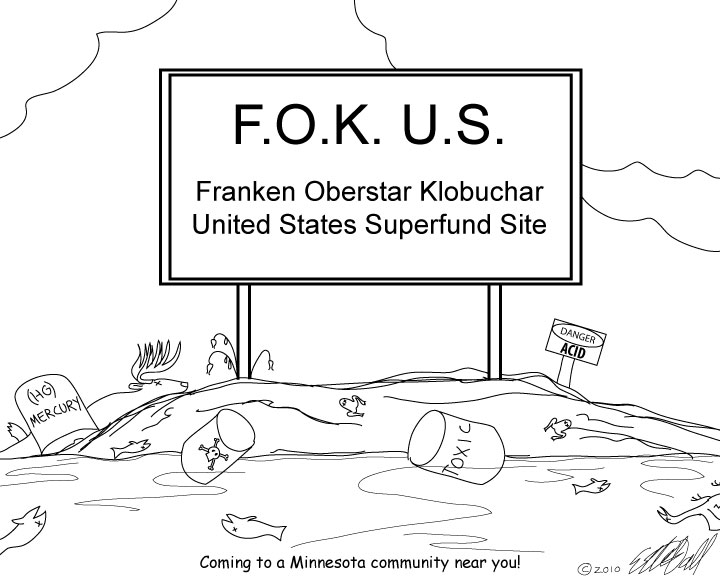
“Trust Us…We will do it Right this Time.”

F.O.K.  U.S.

F.O.K. U.S.

Illustration by: Elliot Dahl
View more of his work at www.elliotdahl.com

Comments on Polymet DEIS by Native Americans address Critical Issues

Issues raised by Native Americans in their “POLYMET DEIS –Tribal Cooperating Agencies Alternative Findings and Perspectives” should be seioursly heeded by the DNR and regulatory agencies.  This is a through analysis of the DEIS and will be ignored or maginalized by “the powers that be” at the peril of all peoples of Minnesota.  We are just hoping someone is listening and paying attention to these thoughtful citizens.

For example, for those who are interested in the science and claim little or no impact, that is highly debatable.  The Cooperating Agencies write,

“The view that mine pit dewatering impacts will be very limited or non-existent (Adams, John and Michael Liljegren. 2009 “Additional PolyMet peatland data / information.” email communication to Stuart Arkley. February 1, 2009) is based on the assumption that there is little or no connection between  the bedrock and surficial aquifers (GLIFWC 2009, Memorandum to Jon Ahlness and Stuart Arkley: Photographic evidence for pit impacts to wetland hydrology.  April 24, 2009). However, the scant data that does exist characterizing mine site hydrology suggests that there may be substantial connection between the bedrock and surficial aquifers.”

How can any scientist claim “limited or non-existent impacts”  when in fact the science “suggests that there may be substantial connection between the bedrock and surficial aquifers.”  If there is any question at all, we should not proceed.  When we know for certain our waters will not be polluted, then we may proceed.

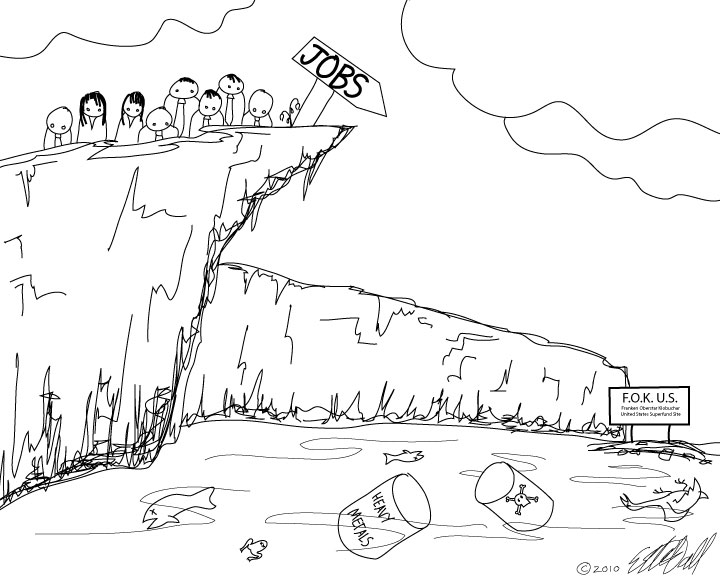
Jobs

Jobs, Coming to a Minnesota Community Near You!

Jobs, Coming to a Minnesota Community Near You!

I,ve heard the argument recently that “All” companies have made improvements in environmental stewardship in the last few decades and that our regulators are just doing a “great” job of protecting us against pollution.

Please watch the PBS film by Frontline “Poisoned Waters.”  Then come back and tell me what a great job we are doing in the U.S. to protect our waters, our health, and our communities long term viability.

At this critical time in our Nations history when we need, no must, reverse our decades long abuse of our planet.   We must find ways to create jobs that contribute to the health of our children and our families, our communities, and the environment.

Trusting in industry and our regulators and politicians is what has gotten us the “Poisoned Waters” that the PBS film is about.  Watch the film, unless you just don’t want to know what’s happening in your world.  Then just trust.

Illustration by: Elliot Dahl   View more of his work at www.elliotdahl.com

PolyMet using state’s waters as testing ground

Are the waters of Northeastern Minnesota less precious than those of Wisconsin?

Wisconsin will not allow sulfide ore mining until it can be proven that it can be done without harming the environment. No mining company has done that.

The waters of Northeastern Minnesota could be a testing ground for PolyMet’s unproven methods. The damage to our environment and the taxpayers’ cost for cleanup could last decades longer than the jobs.

Mary Thompson

Duluth

Beware of PolyMet

Published: Saturday, December 26, 2009 10:48 PM CST

Mining companies have one reason for setting their sights on Northeastern Minnesota: Extracting minerals.

They have no benevolent desire to create jobs or pay taxes. They have poured millions of dollars into public relations campaigns convincing and promising regional politicians that their project is the economy’s “savior,” knowing that if they spent enough time and money hyping job creation, they would be able to railroad through environmentally-risky mines. Has anybody looked at how PolyMet came up with its 400 jobs number? Or are we supposed to “trust them,” like we are supposed to in every part of the Draft Environmental Impact Statement process?

Making promises is how this industry works. PolyMet mining will not be done right. Their DEIS points to numerous pollution problems. This is a low-grade ore deposit that has never been mined in Minnesota. The company will have neither the incentive nor the resources to clean up their toxic messes.

PolyMet is vigilant in its claim that we need these metals for electronic products. Along with their hype of jobs, PolyMet’s propaganda for mining these dangerous sulfide ores is based on a fear of product shortages. None exists.

However, clean water is undeniably scarce … and priceless. Damage to it is irrevocable. Contrary to what the politicians would like us to believe, there are countless vacationers to Minnesota and thousands of concerned Minnesotans who have serious issues with this proposed mining project.

We may be Minnesota nice, but we aren’t Minnesota stupid.

Jane Koschak

Ely

Hunting and angling groups call for PolyMet accountability

December 21, 2009

Members of Minnesota’s hunting and angling community issued the following statement over the weekend. It highlights many of known concerns about the PolyMet Draft Environmental Impact Statement and demonstrates how this issue is of concern to a broad segment of Minnesota’s citizens:

Sportsmen’s coalition supports holding PolyMet fully accountable for watershed and waterways pollution

2,000 years of contamination for 20 years of copper mining

DULUTH—An ad hoc coalition of hunting and angling groups formally requests that legislation be passed by state lawmakers holding Canadian mining company PolyMet fully accountable for any and all costs associated with remediation and cleanup of its proposed copper-nickel mining operations near Hoyt Lakes, Minn. If this can’t be accomplished—thereby protecting taxpayers from a cleanup tab that could amount to hundreds of millions of dollars—no copper-nickel mining should be allowed.

The coalition of groups, which includes the Minnesota Division of the Izaak Walton League of America and the Backcountry Hunters and Anglers, consists of sportsmen and women and others who understand the priceless value of clean watersheds and crystal clear lakes, streams, and rivers that supply Minnesotans with clean drinking water and unparalleled outdoor recreation opportunities.

And we have serious concerns about the seemingly reckless rush of some northern Minnesota legislators and others to approve PolyMet’s proposed mining operation on the former LTV Steel Mining Co.’s taconite plant near Hoyt Lakes.[1] Especially considering that these same lawmakers stymied attempts to pass common sense legislation ensuring that taxpayers won’t be saddled with decades of remediation and toxic waste cleanup costs after PolyMet officials pack their bags and head back to Canada.

Today, the Environmental Protection Agency estimates that 40 percent of western headwater streams are polluted by abandoned mines, which poison rivers, creeks, and watersheds with sulfuric acid and heavy metals such as lead, cadmium and arsenic. High-end estimates of the number of abandoned mines range up to half-a-million. The projected cost to clean them up could be as high as $70 billion.[2]

Hardrock mining imperils watersheds and fish habitat because mineral ores are infused with sulfides. When mining puts the ore into contact with water, the result is acid runoff that pollutes lakes, rivers and streams, oftentimes killing all aquatic life.[3] For example, in South Dakota the Dakota Mining Corp. extracted nearly $70 million worth of precious metals from public lands, then went broke in 1998, abandoned the mine, and left behind a 100 million gallon pond of acid and toxic heavy metals. The cleanup cost is estimated at $40 million—more than seven times higher than the cleanup bond the company posted, shifting the costs onto taxpayers.[4]

At Summitville, a mine in Colorado, a bankrupt Canadian company has left the nation’s most costly mine cleanup. It will take 100 years and cost $235 million to clean up the release of cyanide and acid mine drainage that has left 17 miles of the Alamosa River devoid of fish and other aquatic life. The mine was permitted as a ‘zero discharge’ mine.[5] Montana and Wisconsin have since banned similar mines as a result of these and other disasters.

It’s clear to us that PolyMet’s Canadian officials don’t want to be held financially responsible for their mine’s cleanup and reclamation costs because they know that the long-term environmental damage to our watersheds, waterways and other natural resources will likely exceed the value (many times over) of the copper and other minerals they manage to extract from the ground. PolyMet’s draft environmental impact statement (DEIS) says as much, stating that:[6]

  • Water leaching from the waste rock piles is expected to be contaminated for up to 2,000 years.
  • The West Mine Pit will overflow at Mine Year 65 (45 years after expected mine closure), contaminating the adjacent Partridge River with sulfates and heavy metals.
  • Groundwater at the mine site is expected to exceed water quality standards.
  • Due to structural instability, the tailings basin has a “low margin of safety.1″[7]

It’s also clear that PolyMet’s proposed mining operation will most likely contaminate waters that flow into the Boundary Waters Canoe Area Wilderness and tributaries of Lake Superior.[8] The very lifeblood of northern Minnesota’s economy is its healthy watersheds and waterways, but PolyMet’s proposed mine waste will be leaching sulfuric acid into those same northern Minnesota waterways “for up to 2,000 years.”

In essence, what this amounts to (i.e., not holding PolyMet accountable for remediation and cleanup costs) is a corporate bailout for a Canadian company. American’s hard-earned tax dollars shouldn’t be used to subsidize foreign companies who are going to leave us with a legacy of 2,000 years of poisoned lakes, streams, and rivers. Adding insult to injury, the raw materials dug up from Minnesota’s public lands are going to be sold on the world market, very likely to countries with emerging economies, like China.

We end by asking a simple question: is 20 years worth of copper mining jobs worth 2,000 years of poisoned waterways and watersheds that will cost the rest of us millions, and possibly billions, to clean up? The risks to taxpayers and northern Minnesota’s waterways cannot be overstated and should not be brushed under the rug by short-sighted legislators. If PolyMet officials won’t agree to abide by tough, common sense legislation that requires them to be held fully accountable for all future remediation and cleanup costs, thereby protecting taxpayers from having to pay to clean up their toxic mess, it’s time to send them back to Canada.

Coalition Spokesmen:

Len Anderson
Izaak Walton League
218-879-6521
bander@northlc.com

David Lien
Backcountry Hunters and Anglers719-650-6526
dlien2@yahoo.com

Darrell Spencer
Izaak Walton League
218-724-4226
ds@leaveatrail.biz

[1] Charley Shaw.  “Copper controversy.”  Capitol Report: 2/23/09
[2] Tom Kenworthy.  “Prospecting Reform: Will Congress Finally Overhaul The General Mining Act of 1872?”  Trout: Fall 2008, p.23
[3] Roger Di Silvestro.  “A Legalized Assault on Public Lands.”  National Wildlife: April/May 2008
[4] Jim DiPeso.  “The 1872 Mining Law: Trumping Capitalism and Conservative Principles.”  C.E.P. Quarterly: Winter 2006
[5] Ryan Hunter.  “3,000 Acre Copper Mine Proposed Near Mount St. Helens.”  BlueOregon: 2/10/06
[6] Friends of the Boundary Waters Wilderness (FBWW).  “DNR schedules PolyMet public meetings.”  FBWW: 11/19/09
[7] Friends of the Boundary Waters Wilderness (FBWW).  “DNR schedules PolyMet public meetings.”  FBWW: 11/19/09
[8] Tom Meersman.  “DNR leaves out public debate at mining project meetings.”  [Minneapolis-St. Paul] Star-Tribune: 12/9/09