A sample text widget
Etiam pulvinar consectetur dolor sed malesuada. Ut convallis
euismod dolor nec pretium. Nunc ut tristique massa.
Nam sodales mi vitae dolor ullamcorper et vulputate enim accumsan.
Morbi orci magna, tincidunt vitae molestie nec, molestie at mi. Nulla nulla lorem,
suscipit in posuere in, interdum non magna.
|
When : Wednesday, April 13 • 4:00pm
Where : Harbor Drive, behind the DECC, Duluth, MN
What : Picket and Press Conference: Stop the Environmental Standards Rollback!
Who : Listen to Bob Tammen Retired Miner from Tower Soudan
The Society for Mining, Metallurgy and Exploration will be holding a conference in the DECC
Tell the industry! We don’t want the state’s water quality standards rolled back to make way for their industry profits!
For more information contact NoMnSulfidemining@gmail.com
By Mike Hillman
A friend of mine told me a few weeks ago that State Representative Tom Rukavina wanted to increase by five times the legal limit we allow for sulfates in our discharge water. “Why would he want to do that,” I asked. “The current standards are too high for the mining companies to meet and they know it”, was my friend’s answer, “They talked to Tommy about their problem meeting the ten milligram standard, that’s why Tom is asking to lower the current requirements.” “So much for meeting the highest environmental standards in the world,” I said in response. It leads to the logical question about the fairness of our environmental standards.
This week the topic of sulfate limits and wild rice was in the local papers, and there was Representative Rukavina asking to have the limits on sulfates raised, because he feels the standards to protect wild rice from mining waste water is too high. Now I know when you serve in the state legislature you have to be familiar with a lot of things, but I was surprised when Representative Rukavina seemed to know something about sulfates and wild rice that the rest of us didn’t know.
Now I’ve heard about people talking about wild rice before, but it’s usually a few weeks before the late summer wild rice harvest, and the talk is about how this year’s crop of wild rice is going to be, not about how much sulfate the plant can tolerate before it stops producing rice. According to some scientists the current level of ten mg per liter is out of line and according to them a level of as high as two hundred and fifty wouldn’t kill wild rice, but Representatives Tom Rukavina from Pike, and David Dill of Orr, said they will settle for fifty as a reasonable compromise. Reasonable by whose standards I wondered.
According to Tom Rukavina it’s not just about proposed sulfide mining in Northeastern Minnesota that’s being hampered by the unreasonable sulfate limits, because many of the man made mine lakes, all across the Mesabi Range, have sulfate levels much higher than the ten mg per liter limit the state now sets as the acceptable standard for sulfates. Rukavina said that many municipal water systems across Minnesota can’t match the standards and people seem to be turning a blind eye to those violations. Rukavina thinks the mining people are being singled out and he feels that’s unfair. So instead of keeping the best water quality standards in the world, Rukavina and Dill want us to lower those standards all across the state. Thank heaven for people who are saying that before we lower the current standards that may be wrong, we should make sure they’re not really right.
I like Tom Rukavina, but I don’t agree with him about changing the rules about sulfates in our water until the state finishes a two year study that will better tell us the truth about sulfates and wild rice in Northeastern Minnesota. Tom Rukavina is from the south side of the continental divide. Where he stands the water runs east and south, and where I stand the water runs north. The water in the St. Louis River is so polluted from mercury from mining waste that the EPCA doesn’t have a plan to deal with cleaning up the mess, and that is a sad thing. Right now the water in the Rainy River Water Shed; the water flowing north to Hudson Bay is in better shape. I want to keep it that way. It would be nice to have high paying jobs, but not if it is going to put poison into our water.
The truth is the mining companies can’t meet the current standards that we have set in order to protect Northeastern Minnesota from pollution and degradation, and they know it. I hope we take the two years to study the issue, and find out for sure just what a fair and safe measure for sulfates going into either of our major water sheds. The rock here has been waiting two thousand eight hundred million years, so two more years maintaining current standards doesn’t seem a lot to ask.
 STREAMLINING POLLUTION STREAMLINING POLLUTION
Editorial Comment: This is in our opinion one of the very best summaries of the state of the development of Cu/Ni Hazardous Chemical Processing/Mining written to-date. If you have any concern for the health of the citizens of Minnesota and the state itself, you should take a few minutes to familiarize yourself with this post, tell your friends, and especially jab any politicians you can reach with it. (rw)
On March 3, 2011 Governor Dayton signed into law legislation to streamline the environmental review process for businesses and industries seeking permits (H.F. 1). This legislation directly fast-tracks proposed copper-nickel sulfide mining in Minnesota.
Minnesota’s Strict Standards
Iron Range legislators and mining company officials have repeatedly stated that copper-nickel mining is best done here in Minnesota, with our strict environmental laws. PolyMet, Inc. has spent five years trying to make its way to permitting. After four years of environmental studies, the project’s Draft Environmental Impact Statement (DEIS) was released in November of 2009. Citizens who combed through 1800 plus pages of the DEIS found few details for treatment or mitigation of likely violations of water quality standards. In February of 2010, the Environmental Protection Agency (EPA) rated the DEIS as EU-3, Environmentally Unsatisfactory-Inadequate. In short, metallic sulfide mining cannot be done in northeast Minnesota without polluting the watershed for centuries to come.
One year later, we have a Democrat governor dependent on the votes of the Iron Range and a Republican-dominated legislature bent on facilitating industry. The result is a race to see who can do the most to facilitate the permitting of copper-nickel mining. Without the weakening of current regulations, the mining of sulfide ores cannot meet state standards. Lowering our standards puts northeast Minnesota on par with third world countries.
Citizen Legal Appeal and Iron Range Resources
In January of 2011, the Iron Range Resources Board (IRRB) was served notice of intent to sue by five environmental groups. The groups gave notice that a $4 million loan to PolyMet for land purchase was illegal per the Minnesota Environmental Policy Act (MEPA) as being done ahead of, and with the possibility of influencing, the permitting process.
PolyMet’s open pits would be located on land that is currently part of the Superior National Forest. According to Federal law, open pit strip mining operations are prohibited on USFS land originally purchased under the Weeks Act for watershed protection. The USFS has been ducking this issue for the past 5 years. The USFS could have denied PolyMet the surface use of its lands. Instead they have initiated a draft EIS process in preparation for a land exchange with PolyMet. The 6,700 acres needed by PolyMet include over 1000 acres of high functioning wetlands that are ARNI (Aquatic Resources of National Importance). To find land parcels of equal value for PolyMet to purchase for exchange may be difficult and costly. Hence the IRRB loan.
The IRR is a state agency that is funded by taconite production taxes paid in lieu of property tax, managing approximately $40 million a year to assist with Iron Range economic development and diversification. In order to evade the law suit and allow the PolyMet loan to go forward, the streamlining law specifically exempts the IRRB from prohibition to perform actions to promote a project before environmental review is complete.
The streamlining law also removes citizen rights to use Minnesota district courts for environmental law suits. All suits must now go through a more expensive Minnesota appeals court process. The constitutionality of altering jurisdiction and bypassing district court appears questionable. Litigation is the only avenue granted citizens as a means of seeking recourse for harm.
The new streamlining law affects all industrial projects, including Concentrated Animal Feeding Operations (CAFO’s), coal power plants, nuclear plants, ethanol plants, agricultural operations, and garbage incinerators, among others. Smaller projects may be exempted from environmental review altogether.
Proposers Can Draft Own Environmental Review
The new law allows project proposers to prepare their own environmental review. When companies hire their own consultants, much of the information presented to the agencies for evaluation can be considered proprietary. The agencies must then rely on figures given by the company or perform duplicate studies. Under these circumstances, it is difficult to evaluate potential impacts.
When companies control the environmental review process, citizens lose access to reliable technical information. In addition, citizen response time to the review, no matter how complicated, is now limited to 30 days.
Lowering Minnesota Standards
Another regulation under reconsideration is the Minnesota standard of 10 mg/l of sulfate in the state’s watersheds. Studies show that wild rice was abundant in the upper St. Louis River watershed prior to the 1950’s, before taconite mining. Remaining wild rice stands have stunted growth. The tailings basin formerly owned by the LTV taconite company and purchased for use by PolyMet is currently leaching sulfates and other contaminants into the St. Louis River watershed.
Both taconite plants and their coal fired power suppliers release mercury into the air. When sulfates are present in the watershed, they become part of a biochemical process that converts mercury into methylmercury, the form that bio-accumulates. There are now fish advisories on most northern Minnesota lakes to limit the amount of fish eaten per week. Advisories are based upon studies that show the human body can excrete limited amounts of mercury. But that amount can still be toxic to infants, young children and the elderly. Mercury has been implicated in lowered IQ, autism symptoms, neurological symptoms, and Alzheimer’s disease.
It is known that Minntac’s taconite tailings basin is leaching 3 million gallons per day of sulfates and other pollutants into two watersheds. Minntac is also seeking to release recycled water that has been used in plant operations since start-up and is becoming corrosive to plant equipment. The DNR has not been able to figure out where best to divert this contaminated water. Unfortunately, governmental agencies have been lax in forcing taconite operations to meet state water quality standards. The result is the loss of wild rice crops and the fact that the St. Louis River Watershed is so contaminated with mercury, the MPCA cannot conceive of a plan to clean it up.
Meanwhile, state representative Tom Rukavina is proposing to increase the sulfate limit. Rather than insist that our waterways be cleaned up, Rukavina plans to pave the way for both the expansion of Minntac and the opening of an entirely new sulfide mining district, which would greatly increase the amount of sulfates, mercury, and toxic heavy metals in the watershed.
His basis for doing this is to promote 360 projected PolyMet jobs. If our area legislators took as much interest in Cirrus Aircraft in Duluth, which is in the process of being sold to a Chinese company, they could save 500 already existing local jobs.
Copper-Nickel-Precious Metals as Strategic
Newly elected US 8th district representative Chip Cravaack is also in the mix to facilitate sulfide mining. He claims this mining is necessary for strategic US interests.
Mr. Cravaack is either neglecting to notice, or has not been informed, that PolyMet is a Canadian company, that all of PolyMet’s metals would be semi-processed and need further smelting, and that PolyMet has a market agreement with mining conglomerate Glencore to sell its metals on the global market . Inquiries for purchase of these semi-processed metals are coming from China. Both China and India are stockpiling metals as they seek to become the world’s next industrial giants. The US would need to buy these metals back from our major competitors.
However, it is to mining company advantage to have Cravaack claim that these metals are strategic. According to the Boundary Waters Canoe Area Wilderness Act of 1978, the BWCAW can only be mined in the case of national emergency. Twin Metals and others have deposits which border the BWCAW and dip down under the wilderness. By claiming these metals as strategically important, Cravaack could be facilitating the opening of the BWCAW to mining operations. Cravaack would do better by the citizens of this country if he would research the recycling of metals from military equipment for strategic use.
Financial Assurance
Other legislation to promote mining is also winding its way through the corridors of the State Capitol. Observers have noted that Brad Moore, formerly of the MPCA and now working for PolyMet, and LaTisha Geitzen , Environmental Affairs for PolyMet, have been wandering the halls with their input. PolyMet staff is essentially helping write legislation conducive to mining.
Among these issues is financial assurance. Some environmental groups have been arguing that sulfide mining should only take place with strong financial assurances, so that tax-payers won’t become responsible for superfund clean-up costs some thirty years or more down the line. PolyMet currently does not have enough assets to begin mining; investor money is needed for plant start-up, not financial assurance. In addition, the requirement of large amounts of financial assurance would notify investors that his project carries huge environmental risk. So it is in PolyMet’s best interests to have the current friendly legislature enact legislation guaranteeing minimal financial assurance responsibility for any sulfide mining project.
Streamlining a Toxic Environment for Future Generations
While legislators have jumped on a band wagon to facilitate sulfide mining, they have lost sight of the long-term consequences. The mining of less-than-1% ores results in 99% waste rock. The cost of fuels, equipment, machinery, electricity, chemicals, and transportation are all projected to rise. The potential for these mines to remain operational for more than twenty years is highly doubtful.
Both Japan and Canada are already developing industries that will recycle all electronic waste. They are realizing that electronic equipment is being updated so quickly, we cannot manage the resulting waste stream. Also, as oil prices continue to rise, demand for many products will decline, while citizens start looking for energy efficient solutions.
Our legislators seem to be unaware of these future trends. We, as citizens, must stand up and defend the rights of our children and our grandchildren to a future that is based on clean water, clean air, and a healthy environment. The jobs most needed right now are those that will clean up our toxic messes and take us to a sustainable future. To facilitate the opening of a copper-nickel sulfide mining district in the Arrowhead Region of Minnesota when the state cannot manage the pollution created by taconite mining is irresponsible policy. Our legislators and governmental leadership must be held accountable.
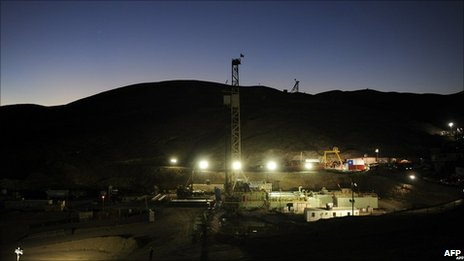
Chile Congress blames San Jose mine owners for collapse
San Jose mine at night The miners spent 69 days underground after last year’s accident
Continue reading the main story
Related Stories
* Reflections on 2010: Chile mine rescue
* Chile mine agrees to sell assets
* Miners clock off 69-day shift from hell
A congressional commission in Chile has blamed the mine owners for the rockfall which left 33 men trapped underground for 69 days last year.
The commission said Alejandro Bohn and Marcelo Kemeny were guilty of negligence, a charge they deny.
The investigation also concluded that the Chilean mine safety regulator bore some responsibility for failing to enforce its rules.
Workers said the mine lacked basic safety standards.
The commission unanimously found mine owners Alejandro Bohn and Marcelo Kemeny responsible for the collapse in August 2010, which cut off the miners at a depth of more than 700m (2,300ft).
Safety failings
Alejandro Garcia Huidobro, who lead the congressional commission, said Sernageomin, the state body tasked with regulating the industry, was “administratively responsible” for the accident.
The commission has handed Mining Minister Laurence Golborne suggestions on how Sernageomin could be improved.
Congress is expected to vote on the suggestions put forward by the commission on Thursday.
Mr Golborne praised the work of the commission, which took five months to draw up the report.
He said some work had already gone into strengthening Sernageomin by increasing its budget and the number of safety inspectors.
Relatives of the miners and some of the men themselves have fiercely criticised the mine owners, accusing them of ignoring safety guidelines, and Sernageomin for not closing down the company despite three deaths at its mines over six years, and dozens of accidents.
The BBC’s Gideon Long in Santiago de Chile says some of them are pursuing legal challenges against the mine owners.
He says the miners want compensation, and some of them have said they would like to see Mr Bohn and Mr Kemeny sent to jail.
The fate of the 33 men trapped in a hot, dark tunnel for 69 days gripped the attention of people around the world.
Millions watched as they emerged one by one from underground after a massive rescue operation had managed to drill a hole large enough to pull them to the surface.
 Human Nature is that component that creates mining with severe environmental loses or allows highly dysfunctional individuals to run amok until they cause severe human losses including death, eg. Bernie Madoff or Chralie Sheen, or the young man who shot Senator Gifford. Corporate Nature is that component that insists upon profits as the only motive and goal of all Corporate decision making e.g. the recent Chilean mining disaster, BP, or Enron and a myriad of other examples. Political Nature is that component that blows with the wind that carries the most financial benefit to the politician (supposedly his constituents) or gets him off the then prevalent “problem of the day” the quickest without the politician having to think of the long term, eg Tom Delay and Jack Abramoff or Gov. Walker in Wisconsi or Pawlenty’s no taxation, while increasing “fees” and doing away with necessary human services. Can you say I-35 bridge collapse. Oh yes that brings up another important component of Human Nature. The Human must deny responsibility for the very nature, his or hers, that has caused the disaster. Absolute denial! You’ll see that in the post of the report on the Chilean mine disaster. The independent report indited the owers as being responsible, they deny it publicly immediately with panache. Human Nature is that component that creates mining with severe environmental loses or allows highly dysfunctional individuals to run amok until they cause severe human losses including death, eg. Bernie Madoff or Chralie Sheen, or the young man who shot Senator Gifford. Corporate Nature is that component that insists upon profits as the only motive and goal of all Corporate decision making e.g. the recent Chilean mining disaster, BP, or Enron and a myriad of other examples. Political Nature is that component that blows with the wind that carries the most financial benefit to the politician (supposedly his constituents) or gets him off the then prevalent “problem of the day” the quickest without the politician having to think of the long term, eg Tom Delay and Jack Abramoff or Gov. Walker in Wisconsi or Pawlenty’s no taxation, while increasing “fees” and doing away with necessary human services. Can you say I-35 bridge collapse. Oh yes that brings up another important component of Human Nature. The Human must deny responsibility for the very nature, his or hers, that has caused the disaster. Absolute denial! You’ll see that in the post of the report on the Chilean mine disaster. The independent report indited the owers as being responsible, they deny it publicly immediately with panache.
We are about 150 years behind in owning up to our human nature to ask more from the environment than we give back. We can no longer take and only put pollutants back into the earth. We MUST STOP. That doesn’t mean we have to stop mining or chemical processing or extracting our presious oil and natural gas. But, it does mean we have to recognize our nature and history for what it is, a VERY poor performance so far, and agree to stop polluting the earth during these processes. Totally STOP!!! We can do it right, but our nature and our history indicate we will not unless every precaution, assurance, and guarantee is in place, with adequate penalties (not our usual political pardons and corporate excuses) are in place so that the human will want to do right, the corporation will only profit by doing so, and we give the politicians all the credit for making it happen.
We are going to follow this post with as many examples of this trifecta, Human, Corporate, and Political nature as we can find. Feel free to contribute what you know or find.
Fool Me Once; by Mike Hillman
When the Wilderness Bill was signed into law back in 1973, I congratulated an old friend who had worked long and hard to see the Boundary Waters Canoe Country a designated as a wilderness area. I thought that with the passage of the Wilderness Bill, which prevented mining, logging, and any development in the Boundary Waters; that the area was safe from exploitation. My friend smiled at me and told me that the area would never be safe, because the work done by one generation could be easily undone by any future generation who deemed it necessary to take what they needed from the area. All it would take was a two thirds majority of Congress and a Presidential signature and the Wilderness Bill would be null and void. I didn’t realize how prophetic his words were, and that it would be my generation that would have to decide the issue of mining again on the edge of the Boundary Waters Canoe area in the heart of the Superior National Forest, but less than half a century later, that is exactly the decision that we are going to have to make.
Many people are of the opinion that sulfide mining isn’t a question of if, but rather a question of when it will happen. To many it is only a question of time. To many the issue is all a matter of time and need before we allow the world’s second largest formation of copper and nickel to be developed by foreign owned mining companies.
There is no question that with the world’s population is getting bigger, and that we are seeing an increasing demand for metals like copper and nickel. To many people it makes good sense that the people of Minnesota should seize this opportunity of need to begin mining near Ely and Babbitt. The world needs more and more copper and nickel for things like computers, cell phones, and all kinds of other gizmos and gadgets; some of which haven’t even been thought of yet. The pro mining people tell us there is no time like the present, and that the mistakes made in the past by mining companies are just that; mistakes from the past which won’t be duplicated in the future. The pro mining people tell us that rather than going to Africa, where the world’s largest reserve of copper and nickel is located, that it would be better to mine Minnesota. Their reasoning is that we have better mining laws here, and stricter environmental regulations that would insure the mistakes of the past won’t be repeated next to one of the nation’s last reserves of unpolluted fresh water. The pro mining people are telling us that as long as the grass grows, and the wind blows, and the rivers flow; we will protect the integrity of the land. It is an easy promise to make, but not to keep.
The truth is that the laws that govern mines in the United States haven’t changed since the late nineteenth century when all America was concerned with was answering the needs of a growing population. It was the time of robber barons and big trusts who were concerned with exploiting our national resources without much thought to the long term costs of that exploitation. It was the age of Manifest Destiny when America believed that we were God’s chosen people, and that the reason he blessed us with so much was that he wanted us to go out and conquer the wilderness and harness all that bounty. Northeastern Minnesota was one of those places that paid a great price for the Carpe Diem philosophy of the time which was grab all you can today and let tomorrow take care of it self.
Today’s mining people are trying to tell you that Minnesota has a chance to do something locally that will have great global impact. Give us your copper and nickel; let us mine your precious metals, the nation and world needs your resources like it never did before. The world needs what you have, and we owe it to the world to give the world its due. Haven’t we heard the same rhetoric before? Back then it wasn’t the world that needed what we have, back then it was the nation, and we gave them everything we had. When the big lumber companies came to log the great pines they took everything they could get. The logging company propaganda told the people of Minnesota that there were so many pines that we could never cut them all. In less than thirty years all the pines were gone, and the logging companies moved west. They left stumps and slash but that’s all we got in way of compensation. When the mining began in the 1880’s the mining propaganda loudly proclaimed that there was so much iron in Minnesota that we could never mine it all. In less then a century all the natural iron was gone from our three iron ranges. We were left with pits and rock dumps. The mining companies took the iron, and we got the shaft. And now they are ready to shaft us again.
I have been told that desperate times lead to desperate measures. Are we really so desperate that we will bargain our long term future for short term prosperity that will leave our children and grandchildren the same pits and waste dumps that we see all over the Mesabi Iron Range? If that were all the negative impact perhaps we would enter the same bargain; but sulfide mining isn’t like grandpa’s iron mine, and it isn’t your father’s taconite mines. They only impacted the land. This time the impact will be two fold: Sulfide mining will scar the land and pollute the water.
So far, the only person, other than the mining companies themselves, writing in favor of the sulfide mining is Doctor Kent Kaiser, who has written at least two pieces on why we should allow sulfide mining around the Ely area. Those two articles appeared in the Ely Echo where Doctor Kaiser was welcomed as a guest of the paper. Kent Kaiser isn’t a Doctor of Mining; he is a Doctor of letters, and a master of propaganda.
His articles are filled with lofty rhetoric about new and improved mining technology, but when I tried to contact him as to where I could find a single example of this new and improved mining technology I didn’t get an answer back from him. The reason I didn’t get an answer back from Kent Kaiser was because there really isn’t anything new or improved about sulfide mining. The truth about mining is that while it has gotten bigger in terms of the size of the equipment used, mining really hasn’t gotten much better over the passage of time.
The truth of sulfide mining is that they will pulverize millions of tons of rock in order to produce a few thousand tons of copper, nickel, and other precious metals back for their efforts. The ratio of what they will keep as to what they will actually use is in some cases as little as two percent return. That means that for every ton of rock they mine they will take twenty pounds of product and leave over nineteen hundred pounds of pulverized waste that will be pumped to a safe place where it will be held back by dikes. The life of the sulfide mining will be lucky to last two generations, and then it will be finished. When they are done the mining companies involved will leave the area just like the logging and mining companies did previously. But this time the waste will contain poisons that will sooner or later work there way into our lakes and rivers. One of the mining people told me not to worry about that, because by the time that happens we both will be dead. Then he went on to tell me that the acid pollution I am so concerned about won’t be any stronger than orange juice. I asked him if anything can live in orange juice he looked at me like I was crazy. When I then enquired what the worst case scenario would be, he told me, off the record, that the worst case would be dealing with sulfuric acid.
The truth is that if we allow sulfide mining to happen in the Ely area, there isn’t a place where we can dump so much sulfur laden waste rock anywhere in Northeastern Minnesota that it won’t fail to pollute or water system. The old saying goes;”Fool me once and shame on thee. Fool me twice, and shame on me.” With the stakes so high we can’t afford to be fooled even once. The last of the big timber in the Ely area was gone in the 1920’s. The last iron mine closed in 1967. The only reason Ely-Winton and Tower-Soudan are still here at all is because they are surrounded by beautiful lakes and rivers. If we take care of those beautiful lakes and rivers generations of people will keep coming here and we will have a resource that will last as long as the grass grows, the wind blows, and the rivers roll on to Hudson’s Bay. But if we put all that beauty in jeopardy; for a few years of limited prosperity, it will mark us down to the latest generation, as nothing more than a generation of desperate people who gambled away their rightful inheritance for a pocket full of empty promises. There is much truth to the saying that practice makes perfect. Let the mining companies go to Africa with their grand promises, and let them demonstrate to the world they really can do it right. It seems to me that based on their dismal record of the past, that they could use all the practice they can get. Until then let us keep the Superior National Forest and the Boundary Waters Wilderness area just as they are.
If you are aware of the Cu NI Hazardous Chemical Processing that too many MN Politicians are attempting to ramrod down the throats of MN citizens you know of Bob Tammen. Bob is a soft spoken, well spoken, older gentleman (my age) with more mining experience than 99% of the Politicians we’re having to inform. He presents un-emotionally the facts of this situation and has for the last 5-6 years, ever since it became obvious that large sums of money were beginning to flow toward these projects without adequate examination of the risks to our water and environment. Many politicians today believe that the environmental process has slowed the progress of “Jobs, Jobs, Jobs..: as they like to say. But, watch the video and you will see who really has been responsible for the slow progress of this industry.
Video: Bob Tammen’s comments to State Senators in Hibbing recently.
Dear friends,
I don’t do this very often, but this is a call to rally the troops.
As you likely know, folks in Michigan’s far North in the Upper Peninsula have been battling Kennecott for nearly five years now. Kennecott/Rio Tinto proposes to blast a portal to its new metallic sulfide mine through a sacred site to the Ojibwe known as Eagle Rock, Migizi Waasin. Recently, it seems, Kennecott (the same company that mined at Ladysmith and is proposing to mine in Aitkin County, Minnesota as well as in Michigan) made a big mistake and arrested a citizen for sitting on a stump with her dog on public land, close to Eagle Rock. The company has a pending lease for the property, but it is conditioned on the company first receiving all necessary permits to mine. One permit (from the EPA) has not yet been granted, so the land lease is not valid (not that it would be, really, even if they had all of their permits).
Members of the Keweenaw Bay Indian Community have taken a strong stand for the land, for the water (the proposed mine site is about ten miles from the shores of Lake Superior) and the sacred site. Right now, about 5 of them are perched atop the site of the mining company’s proposed portal. They welcome visitors to the site (you do not have to trespass, you can meet them at the end of the road). They need food, blankets, prayers, spiritual support, emotional support and legal support. If you have suggestions or ideas, if you would like to come for a visit, if you need a place to stay or a little funding for gas, please email me (kettu2010@callta.com) or my friend Teresa Bertossi (teresabertossi@gmail.com).
Here’s a link to stories about the issue we face:
http://standfortheland.com/ This is a blog recently put up just for the issue.
http://headwatersnews.net/
http://miningjournal.net/page/content.detail/id/543341.html?nav=5006
I thank you from my heart for your help … in whatever form it might take.
Sincerely,
Laura Furtman
By Mike Hillman:
I was sitting with Bill Magie during the summer of 1973 when Congress passed the Wilderness Bill setting aside over a million acres of Northeastern Minnesota as the only area, east of the Mississippi River, large enough to claim to be a true wilderness area. Taken in combination with the Quetico Provincial Park, of approximately the same size, the Canoe Country is truly a remarkable place. Each year hundreds of people come to the Boundary Waters Canoe Area Wilderness and Quetico Park, to get away from civilization, in order to experience something of the world, the way it used to be.
I was a young man back in 1973 and Bill Magie was an old man. Bill was one of the men, along with people like Sig Olson who worked hard to convince Congress that the Canoe Country was a unique place worthy of being set aside as a wilderness area, for all people down through the generations. I remembered telling Bill that with the passage of the Wilderness Bill, at least two percent of Minnesota was safe from being bought and sold. Bill Magie told me that the Canoe Country would never be safe. I was surprised by what he said that night. I asked Magie why he felt that way. “Someone will always want something from the country, that isn’t good for it. That’s why people like you have to stand guard to protect it, when people like me and Sig Olson aren’t around anymore.”
I didn’t know what Bill Magie meant back in 1973. It’s taken many years for the wisdom of his words to manifest themselves. But now, with the talk of opening up large areas of the Superior Natural Forest to sulfide mining, the truth of what Bill Magie told me almost forty years ago is sinking in. I am one of those people who think that there is no good way to mine sulfide ore in a state with so many lakes and rivers, and so little soil to absorb the sulfuric acid and heavy metals, which are an inevitable by-product of sulfide mining. At first I didn’t know how to oppose those who want to allow this dangerous business from happening. I asked myself what Sig Olson would have done if he were still alive.
That’s why I started writing articles, I hope will make people who love the Canoe Country aware of the danger we are facing from the proposed sulfide mining in the Superior National Forest. I wanted people to know that all the hype and spin the mining companies are claiming about them operating, in a new and better way, aren’t true. One spokesperson for the mining companies, Dr. Kent Kaiser, raised the question that this matter would be best served by leaving it up to the people of Northeastern Minnesota to decide, because they are better informed about the matter. He implied that people living in the Twin Cities or Chicago shouldn’t have a say in making this decision. I don’t agree.
I think Sig Olson would have pointed out that this is the 100th Anniversary of the Superior National Forest. The Superior National Forest was created by President Theodore Roosevelt on the recommendation of the newly created Forest Service, when they found out that close to a million acres of Northeastern Minnesota was left a virtual waste land, after private logging companies devastated the last great eastern pinery, and then moved west; leaving little else but stumps and slash in their wake. Roosevelt created the Superior National Forest in order to insure that when private companies harvested trees, or used the National Forest in any way, that they would be held accountable to insure the continued integrity of a national treasure.
I believe Sig Olson would have done his homework, to try to give the mining companies the benefit of the doubt. He would have realized how much Northeastern Minnesota needed high paying jobs. But he wouldn’t have wanted those jobs if there was an inevitable danger of seriously harming the country he loved. I don’t think Sig Olson would have placed his trust an industry that has never done anything other than take the money and run. With a history of degradation and exploitation Sig Olson would be filled with doubts about all the mining companies’ empty promises. He would have asked the mining companies to show him one good example of where they have left the place in the same condition it was, when they finished mining it. Sig would still be waiting for that answer if he were alive today. I think Sig would have told us to leave the Superior National Forest and the Boundary Waters Canoe Area like they are.
Sig Olson would have read and listened to what the mining companies said, but he also would have looked at what they have done to other places. He would take his pipe out of his pocket, strike a farmer match on his canvass pants, and lit his briar pipe. Then he would think the matter over. Sig would sit down at his type writer in the writing shack, and write his concerns to any who would listen, that proposed sulfide mining in the Superior National Forest is a matter of great national interest. Sig Olson would point out that the issue is greater than a fifty year period of prosperity, and that the real value to America isn’t the area’s minerals, which can be gotten in other places, but rather the billions of gallons of fresh clean water, which are unique to Minnesota, and are of great importance to millions of Americans. Those billions of gallons of clean water are only found in Northeastern Minnesota. Our clean water is a true national treasure beyond price. The Superior National Forest and Boundary Waters Canoe Area are places deserving of our protection now; and for all the generations to come.
By Mike Hillman
Like many people living in Northeastern Minnesota, I’m getting pretty tired of hearing about all the negative things those environmentalists are telling us about what will happen if we allow those foreign mining companies to come here and tap into the second richest undeveloped reserve of precious metals in the world. If God wouldn’t have wanted us to mine them, why did he put them here in the first place? All these extremist groups seem to want to talk about, is all the bad things that are going to happen, if we allow sulfide mining here on the, edge of the Boundary Waters. It’s like these people have some kind of crystal ball that’s telling them the future for heaven’s sake. I’ve been paying close attention to what the mining companies are saying, and I think it’s time we give them a chance to demonstrate all the new technology, that they’re going to use, when they start mining all the valuable minerals that God placed here in Minnesota.
The first point I would like to make is that all these bad mines, many of which are now Super-Fund Clean-Up Sites, aren’t even in Minnesota. In the whole history of mining, there has never been a single instance of any sulfide mines polluting any water in The State of Minnesota. All those Super-Fund Mines are in other places. Many of those mines didn’t have the supervision, or cutting edge technology, that our mines are going to employ here in Minnesota.
You can’t judge the future based on the past. They say that those who don’t know history are doomed to make the same mistakes. The mining companies know better than anyone else that they’ve made some horrendous messes in the past, and they’re really sorry for them. Nobody feels worse about past sulfide disasters in places like Colorado, Montana, Arizona, and Canada, than the foreign owned mining companies. They promise if given the chance that they will do it right this time here in Minnesota. Those past environmental disasters were made by other mining companies, who didn’t have the new and improved, cutting edge technologies that our foreign owned mining companies will use here in Northeastern Minnesota. When I looked at what their new process was, I couldn’t find anything new, nothing that hasn’t been done before, that’s my definition of new. But, if those mining companies say it’s new, it’s got to be, don’t you believe?
I’m sure if those mining companies, who made a fine mess of things all over the world, hadn’t gone bankrupt, that they would have been only too happy to help clean up the mess they made. You can’t ask a bankrupt company to help with anything once they’ve made their money, and finished mining a place. Like the old saying goes, you can’t get blood out of a turnip. No one can ask a company, that’s declared bankruptcy, to help take care of its mistakes. That’s why we have the Super-Fund. The Government Super-Fund has already spent millions and millions of dollars taking care of other people’s messes, but we don’t have to worry, here in Minnesota. The foreign owned mining companies, who want to bring billions of dollars into the local economy, have better ways of doing things now, or so they say. Can’t these worry-wart environmentalists forget about the past, and look towards a brighter and better sulfide mining future?
Why do these environmental groups; Like the Friends of the Boundary Waters, have to be so negative. Don’t they know that millions of Chinese people need to have cell phones, computers, and all the other high tech things that we have here in America. And how about all those people living in India? Shouldn’t they have all the same things we do? Who are we to deprive them of all the high tech stuff that used to be made right here in the USA, but have now been moved overseas, so rich American owned companies, can make even more profit? Where are we going to get the gold, copper, platinum, and nickel that these poor third world people need for their cell phones? I’m sure if they were lucky enough to be sitting on all the minerals we have here in Minnesota, that they would be thanking their lucky stars for all the mining jobs. But because God chose to bless us with tons of valuable minerals, those jobs will be ours. Let’s tell the EPA to stop worrying about the future, so we can start mining today. You can bet those third world people wouldn’t be whining about a little sulfuric acid polluting their Boundary Waters, if they had a Boundary Waters to worry about.
Finally I’d just like to say that even if the worst thing happened, and our mining companies pulled out after making a lot of money for half a century, and then left us to deal with rivers of sulfuric acid flowing right into the heart of places like Basswood Lake, and Lac LaCroix. If that were to happen, it would no doubt kill millions of things like fish, ducks, and loons. People have to realize that even if part of the Boundary Waters Canoe Area was polluted by sulfuric acid and heavy metals, there would still be plenty of lakes in the Quetico-Superior Wilderness Area that wouldn’t be ruined by sulfide mining. God gave us over fourteen thousand lakes in Minnesota, and if a few of them have to die, so that we can have mining jobs today, that’s really a small price to pay. Sulfide mining will fill our schools with children again, and our economy will be humming for half a century. Wouldn’t it be worth the loss of a few lakes and rivers, in order to stuff our pockets now? I say to hell with worrying about rivers of sulfuric acid in the future. We’ve got enough to worry about. Let the future take care of itself. We need to live for today. We need those mining jobs, no matter what it costs our children and grand children to clean up the mess we make today.
|
|
