
Video The one word not in Chip Cravaack’s vocabulary. “ENVIRONMENTAL”

|
||||||
 Regulators need to protect our valuable water. The Cracks in the Copper mining Sales Pitch…becoming clearer. Watch the VIDEO Then comment on what CRACKS you see in the Copper Mining Sales pitch. I have a feeling we’ve just barely scratched the surface here. The slides that Paul Danicic presented during his presentation to the Ely Tuesday Group showed only a few but some of the major faults in the Copper Mining sales pitch we have been hearing for the last few years. And the hiring of Tony Hayward by the industry further bolsters the belief that the mining industry just isn’t serious about “Doing it Right” regardless of how many times they repeat the phrase. But, as we all have learned, via Rupert Murdock and his minions, repeating a phrase often enough and long enough will convince many people of the truth of a blatant falsehood. What other Cracks in the foundation have you found. Please share with us what you know. If we are to protect the air and water of this region, the BWCA, Lake Superior, and all points in between, we must deal in facts and not Sales pitches. There are a lot of ways to create jobs, but only one way to protect air and water. JUST DON”T POLLUTE them in the first place. Thanks to the Tuesday Group for these opportunities to learn and discuss vital issues for our community. And thanks to The Friends of the Boundary Waters and to Paul Danicic and Ian Kimmer for their presentation. 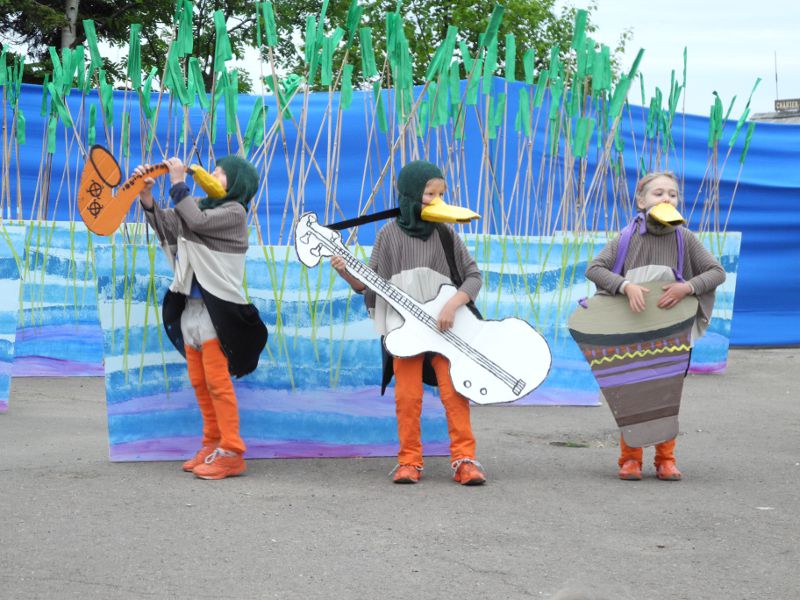 The ducks play a No Sulfide Mining Tune The North House Folk School in Grand Marais hosted this joyful Solstice Puppet Pagent celebrating Minnesota’s Northland. Families and talented participants of all ages joined to together to entertain and inform us of the value of Nature and the threat to the BWCA and Lake Superior region being offered by a new type of mining for Minnesota. The ducks, the youth, the players and the audience voiced a playful but resounding rejection of Sulfide Mining from my point of view. Marco Good, one of the organizers and musicians added, ” I guess it wouldn’t really be fair to say that all those assembled for our pageant were against sulfide mining. But I do hope our sweet little show did work to raise consciousness some.” See the entire presentation from the Good Harbor Hill Players accompanied by the Gamepalaj (the band). Enjoy! Summer suns are glowing, Over land and see Happy light is flowing, Bountiful and free, Everyone rejoices In the mellow rays – William Walsham Howe, 1871 A personal thanks goes to all the artistic, creative, and talented people from the Grand Marais area who worked so hard to make this a joyful evening. I can’t imagine not being at each and every succeeding Solstice celebration you may imagine and present. It is heart warming to see again there is magic and hope even under the darkest of threats. CHEERS! 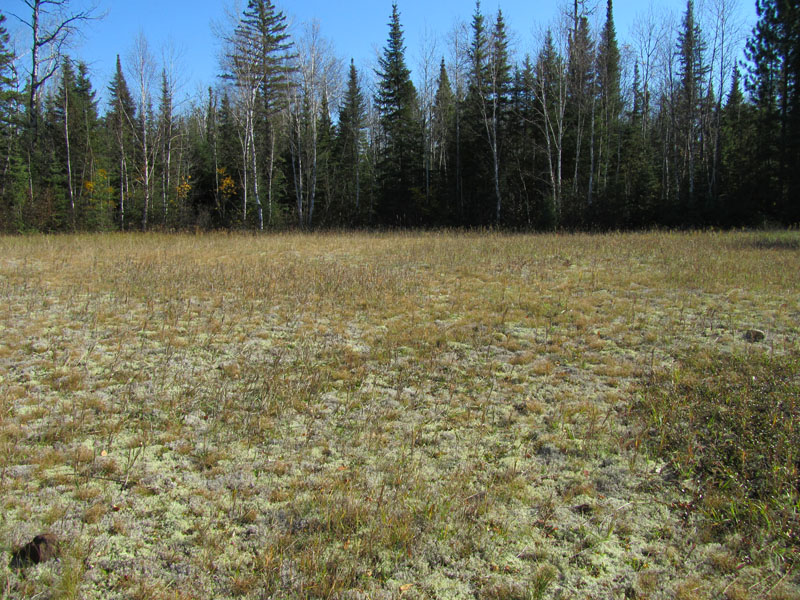 After 30 Plus Years The site we stopped to take a look at is right off the Spruce Road, but not many people driving by the open field, surrounded by woods, know that it is an old mining site. Over thirty years later, the site is still devoid of trees and other small plants, like blue berry, which normally start to take over a site once the tree cover has been cut down. The only things growing in profusion on the old copper-nickel exploration site are several kinds of lichens. Lichens are one of the oldest plants in the canoe country, and in some rocky places, they are the dominant plants. But this old mining site was drilled, blasted, and the required specimens were hauled away a long time ago. The site was covered with gravel and left to nature. I looked at the bald spot in the forest and I wondered what kept it bald for so many years. Was it something in the gravel, or did the old blasting expose enough rock to cause some chemical change that kept the pine on poplar from reclaiming the site? All I know is that this site should have grown up like the country surrounding it, but it didn’t, and that fact bothered both of us. When we got back to the car, I heard an engine like drone that filled the woods with its dull grinding sound. It was the sound of drill rigs. The sound wasn’t deafening, but it was easy to hear. Hearing that dull drone seemed out of place in the Superior National Forest. I told Richard that if we could hear the six rigs on the Spruce Road, you could hear it in the Boundary Waters. Up until now, my only concerns have been for maintaining the quality of our water, but now I realized the impact mining would have on the audio quality of the wilderness. If six drill rigs were this loud, what would two or three mines and a railroad sound like on Gabro and Bald Eagle?
By C.A. Arneson | Wednesday, April 27, 2011 posted in MinnPost.com ELY — In October of 2010 sulfide-metal (sulfide) mining was in the news with the discovery of toxic drainage at a supposedly remediated 1974 International Nickel Co. (INCO) bulk sample site off the Spruce Road — and for ongoing concerns stemming from a legacy of heavy-metal contamination at the nearby Dunka mine. Both sites are near Ely and even closer to the Boundary Waters Canoe Area Wilderness (BWCAW). The Friends of the Boundary Waters tested the unmonitored INCO site and found toxic levels of heavy metals, including nickel and arsenic, far above state standards. If one 10,000-ton bulk sample at the INCO site leaches toxic levels for 30-plus years, what would the legacy be of the 40,000 tons a day that Duluth Metals is proposing to mine? Here is what the area looks like now 30 years later. David Oliver of Duluth Metals has long claimed that any waste rock from a Duluth Metals sulfide mine, the Nokomis Project, proposed for the same area as the INCO site “is deemed below any threshold that would generate acid drainage. It just doesn’t have enough sulfur to do it” [Minnesota Public Radio News, June 23, 2010]. Unpredictable in highly disseminated ore Sulfide mining proponents blithely recite limestone treatment as the answer, never saying that even if they successfully control copper they will still be unable to meet state standards for nickel, which is not adequately controlled by limestone — as demonstrated at the LTV Dunka pit. Nor do they say that Duluth Complex material also contains arsenic that releases at higher pH levels — so the more limestone is used in an attempt to control copper by raising the pH, the more arsenic would be released to our waters. Nor do they mention the inevitable additional mercury contamination of the fish in our lakes, both from sulfide mining and from tremendous amounts of coal-fired electricity needed to power the projects — in many cases tipping the scales to “do not consume.” Today, no technology exists that will in reality protect our waters from sulfide mining. Experiments don’t capture the reality Minnesota Pollution Control Agency (MPCA) Director of Strategic Planning Ann Foss, concerning toxic levels at Dunka not meeting State or Federal standards, said: “They are taking steps to bring down the levels of those pollutants, referring to Cliffs Natural Resources.” [Star Tribune] Glaringly, she did not say they would ever be able to meet State or Federal standards. Legislative assault on our waters Legislators “streamlined” environmental review so public response could be virtually eliminated, ensuring such corporations dictatorial power. Legislators introduced bills to weaken the wild rice sulfate standard in order to allow mining companies carte blanche to damage our lakes, not to mention our health, since higher sulfate levels are inextricably linked to increased mercury levels in the fish we eat. They passed legislation removing the important part of School Trust Lands language that specified, “…with sound natural resource conservation and management principles, and with other specific policy provided in state law,” but retained “to secure the maximum long-term economic return from the school trust lands.” No surprise that 3.5 million acres of school trust lands have mineral rights controlled by the state of Minnesota. Then they passed the Omnibus Environmental Finance bill that would drastically reduce funding and protection for clean water in our state. Sulfide mining companies would be the only winners Once standards are set for sulfide mining at NorthMet, there is no turning back. The same standards would hold for all subsequent sulfide mines, regardless of location. What happens when dangerous contamination is discovered at permitted mines? Historically companies threaten job loss. What if the state wants to shut a polluting sulfide-mining company down? Companies can sue for the value of the minerals they are not allowed to recover. Minnesota would be held hostage while mining companies cite financial inability to meet standards — while contamination of our waters continued unabated. The only winners would be the sulfide mining companies. In 2010, PolyMet executives received $1,670,618 in compensation, a one-year percentage change of 108.56 percent, even though the stock price was on a precipitous downward slide at the time. [Morningstar] Professing to care about our waters — truth or pretense? Tremendous amounts of water and coal-fired, perhaps nuclear, electricity are consumed by sulfide mining. Toxic contaminants would be released to both watersheds and airsheds. Downstream and downwind would have deadly new meaning. One only has to look to Japan to see that in hazardous industry technological miscalculations are inevitable, often with catastrophic consequences. Lest one dismiss nuclear as not an issue here, it must be noted that nuclear waste contaminating the waters of Japan are bio-accumulative — the higher up the food chain the more accumulation — just as sulfide mining waste increases the mercury levels in fish which bio-accumulate in us when we eat them. So Minnesota legislators, in what I hope was mere ignorance, voted to raise the sulfate standard for our waters — which increases the methylation of mercury — so that all of us, particularly our children, could have the opportunity to accumulate even more of it in our tissues. Reality behind the rhetoric Quite simply, lengthy environmental review correlates with abysmally poor-quality projects — such as PolyMet’s NorthMet project that received the lowest rating possible from the EPA. Lori Fedo, president of the Hibbing Chamber of Commerce, testified that if proposed mining operations had been permitted, a long-time Hibbing business would not have closed. If she was referring to PolyMet, it is questionable that mining operations in Hoyt Lakes would have a significant impact on a grocery store in Hibbing. What is clear is that every time minerals run out, mining companies run out of town — and businesses close in towns where there is little left after mining to attract people. Ely was able to depend on its wealth of waters for recovery; will it now become the next victim of the boom and bust cycle? The 360 jobs last projected for PolyMet would be the equivalent of 10 companies, each hiring 36 employees — 10 sustainable, environmentally sound companies. That would be certainly attainable if Minnesota poured the kind of money into attracting them it has spent on sulfide mining — such as the Iron Range Resources and Rehabilitation Board’s controversial $4 million dollar loan to PolyMet. Divide $4 million by ten. Rather than long-term vision, Gov. Mark Dayton and a majority of our legislators chose to make it even harder to protect our waters by weakening Minnesota’s environmental review process with “streamlining.” They failed to recognize process has never been the problem. The problem is the state’s inability to say no to projects that destruct what defines us. The people of Minnesota have another, saner choice Minnesotans have the ability, the opportunity and the responsibility to tell our legislators and our governor to support jobs and businesses that are compatible with our waters. To deliberately choose and shape a vision of Minnesota as a premier state — attracting people to live and work here because we have a wealth of clean water, clean air and an unyielding commitment to keep it that way. C.A. Arneson lives on a lake in the Ely area.
The other day four young entrepreneurs from International Fall were arrested for busting into a hotel down in Eveleth. They broke into the place, because they were there to steal as much copper as possible. Right now the price of copper is so high that people are breaking into places in order to help fill the demand for copper, by stealing as much of it as they can. The price of copper is also fueling the demand of pro mining people to allow them to by-pass current environmental laws so that they can get down to business and take advantage of the current market. A few years ago, the pro mining people told this blogger that the best reason to mine non ferrous minerals in Minnesota is that we have the highest standards in the world, and if the mining is done here, rather than in Africa: It will be better for the world, because then we know it will be done right. Last year one of the companies interested in developing the second largest deposit of copper and nickel in the world, the biggest is in Africa, submitted their EIS to the State of Minnesota, it was rejected as being inadequate. The company plan to mine in Minnesota just wasn’t up to our standards. The state people told the mining company to come back with a better plan. But what if there isn’t a better plan to mine non ferrous minerals in Northeastern Minnesota? What if the EIS was the best the mining people could come up with, and that there really is no safe and good way to develop this vast reserve of potential mineral wealth without forever damaging the quality of the area’s valuable amount of federal water? That just might be the reason Tommy Rukavina and David Dill came out in favor of raising the amount of sulfides we allow to be dumped into our water system. Currently the issue is about the concerns some people have over how much pollution our wild rice crop can take before we kill it. I don’t know if anyone really knows what that limit of tolerance is, and I don’t think many pro mining people even care. Fortunately for the canoe country, there are many people all over the nation and the world who do care about things like water, fish, loons, and wild rice. The only possible hope I see that the two camps might be able to come together on is the possibility that the mining companies would agree to install and operate a sludge treatment plant at each of the mines granted permits to operate in Minnesota. The issue is really one of what will be done with all the pulverized waste rock that in most cases will be over ninety percent waste and less than ten percent product. I would like to see some of the pro mining people join me in calling on the mining companies to admit that unless they remove the caustic chemicals from their waste sludge that there isn’t any good way to mine here, and that if we do open Pandora’s Box we are sure to leave the lasting effects of ruining our water, and forever altering life here as we know it. This issue is all about dollars and cents. The mining companies want our copper for the same reason those four young men broke into the hotel down in Eveleth; they were looking for a profit for their efforts. The price of copper is very high, and these are desperate times. There is no doubt that we have the technology to remove the bad things from the sludge we will have to put somewhere if we allow mining here. My doubts are whether or not the price of copper will ever be high enough to justify the costs of installing and then operating sludge treatment plants. Sooner or later the sludge is going to drain into our water, just like it is already doing in the St. Louis River. There is just no way to prevent that. In time even the best built dikes are going to leak, and if we allow things like sulfur to be left in that sludge we are going to see acid drainage polluting the Boundary Waters. It is only a matter of time. So what kind of town are we? Are we going to take the pieces of silver now, and leave the mess to the future, or are we going to hold to our high standards which now say that if mining can’t be done right, then it shouldn’t be done at all. Picture and Post by Mike Hillman It is shameful elected state and federal legislative members seem to be in collusion with PolyMet to create 360 polluting mining jobs. PolyMet’s proposed mining activity definitely endangers Chippewa Indian spiritual culture and wild rice. Sixty years ago, a scientist for the Minnesota Department of Natural Resources showed that if there are more than 10 milligrams per liter of sulfides in water wild rice doesn’t grow. A state legislator wants to use precious taxpayer dollars to study the same problem. Mining by PolyMet threatens the multimillion-dollar tourist, resort and casino industries. These industries need to get actively involved in stopping PolyMet. Minnesota is tourist land, not yesteryear mining land. This is where the tax dollars are! The mining industry has the Mesabi nugget expansion development, which has created hundreds of jobs. No one talks about the Indian casinos, which employ 12,800 people statewide while also creating thousands of part-time satellite jobs. Casinos saved the state of Minnesota from employment depression. About 70 percent of their employees are non-Indian. The Indian casinos create many jobs that pay state and federal income taxes. Additionally, they give the state of Minnesota billions of dollars through the compact system. We talk about big government, but I believe we need to reorganize state governments. There seems to be much duplication of paperwork and many departments that do the same things. We must not let PolyMet mining pollute the people’s land and water via the discharge of toxic chemical like sulfides. Warner B. Wirta, Duluth Published April 29, 2011, 12:00 AM in Duluth News Tribune PolyMet should not be the only pollution concern PolyMet is the first company to present an environmental impact statement to mine low-grade, sulfide-containing mineral ores. PolyMet has stated it would do what’s necessary to comply with the existing 10 milligrams per liter standard for sulfates. However, if that standard could be increased, it could potentially pave the way for other companies — such as Twin Metals and Franconia — that have been conducting exploratory drilling further north, nearer the Boundary Water Canoe Area Wilderness. Not that the roughly 1,500 acres of wetland that would be displaced by the proposed PolyMet mine isn’t important; it is, but increasing the sulfate standard and the potential of mining near the BWCAW, where sulfate pollution could flow into the BWCAW, would have serious impacts on both the area’s tourism and wildlife. Matt Noll 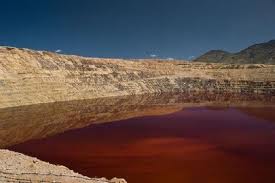 Visit Toxiland But, their long term thinking may be similar to our mining crazy friends in Butte, MT. This video with Jon Stewart and Jason Jones explains it all: Jon pronounces that “In the environmental war, the human race continues to win the war over it.” But, points out that where some only see a large toxic mining pit, “one town see a horribletunity.”
Rio Tinto should be responsible for damage The CEO of Rio Tinto, Tom Albanese, lamented recently that his corporation must do “a better job at managing the curse of resource nationalism … and the activism of stakeholder engagement.” Let me translate that for you: Local people throughout the world are tired of being exploited for profit; they’re starting to stand up for themselves, and Rio Tinto doesn’t like it. Last week I boarded a plane to London, headquarters of Rio Tinto, to join protesters from California, Michigan, Indonesia, Mongolia, Madagascar and London to bring Albanese face to face with “the curse of resource nationalism.” Virtually every country and state where Rio Tinto operates is sending real people to the annual Rio Tinto shareholders meeting to give Albanese an earful. Most adults in Utah know they have suffered, and will likely still suffer for years to come, from a culture of greed, corruption, entitlement and disdain for the little guy that permeated Wall Street, culminating in the collapse of the world economy in 2008. For years, Wall Street suckered Congress into passing laws it knew only it could exploit, and then pushed even those laws to the limit. The average person (you and me) ended up paying dearly, while those who profited like kings escaped not only unscathed but are now making bigger bonuses than ever. There are stark similarities between Wall Street’s behavior and Rio Tinto’s operations in Utah and throughout the world, prompting its stiff opposition to “resource nationalism,” as Albanese puts it. For years, Rio Tinto has manipulated Utah agencies, pushed the permitting process to the limit and operated beyond the constraints and intent of the Environmental Protection Agency, the Clean Air Act and our State Implementation Plan. Rio Tinto now sees much greater profit potential using this well-worn modus operandi in seeking an expansion of its Bingham Canyon Mine. Using the mirage of job creation and the thinly veiled threat of shutting down if it doesn’t get what it wants, Rio Tinto is busy trying to hide its environmental footprint rather than clean up its act. If it succeeds, the economic and health consequences will be long-lasting and borne by the average Utah citizen for decades to come. The Bingham mine’s 23,000 acres currently have no financial bond. As far as I know, this is a highly unusual situation in America. When the mine finally closes, as all mines eventually do, Utah taxpayers will be left with a mess we can’t afford to clean up, toxins in our aquifers and Great Salt Lake, and a mountain range that once beautified and enhanced our vistas, hopelessly and irreversibly disfigured. An expansion of the mine will make all of that even worse and more costly to us. Utah and its government leaders have a choice to make on Utah’s future. We can continue giving preferential treatment to the big polluters — and Rio Tinto is by far the biggest — which will solidify and perpetuate economic dependency on the extraction industries and will discourage companies that would otherwise bring us cleaner jobs. We can inadvertently become the Pittsburgh of the 1950s or Silicon Valley of the 2020s. Granting Rio Tinto a free ride to pollute more certainly steers us toward becoming the Pittsburgh cesspool of the future. We can demand a realistic reclamation bond. We can demand that a small part of Rio Tinto’s profit of $14.3 billion last year be invested in electrical generation sources such as wind and solar that don’t pollute our air. We can demand that Rio Tinto use the best available technology to mitigate its pollution output. It’s technologically feasible, it will provide new jobs, Rio Tinto can well afford it, and to do otherwise simply perpetuates an exploitation of all the residents of Salt Lake County. I plan to ask Albanese in person, “If this expansion is such a great idea for Utahns, come to Salt Lake City and debate your opponents. Come and tell us face to face just how the future health and economic well-being of Utah families are to you just the ‘curse’ of resource nationalism.” |
||||||
|
Copyright © 2026 Ely Minnesota - All Rights Reserved Powered by WordPress & Atahualpa |
||||||
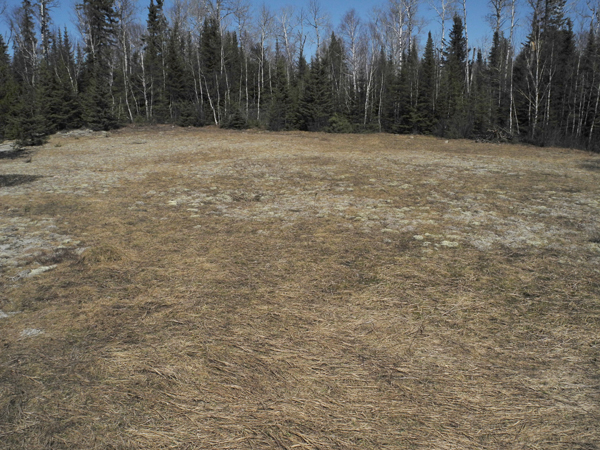 Carla Arneson wrote the following article after visiting the site pictured at the left with a few other concerned and outraged (this is for Gov. Dayton and his group who ask “where is the outrage?,” they don’t seem to be able to act on the facts) citizens. Here is a link to the video made on the same visit.
 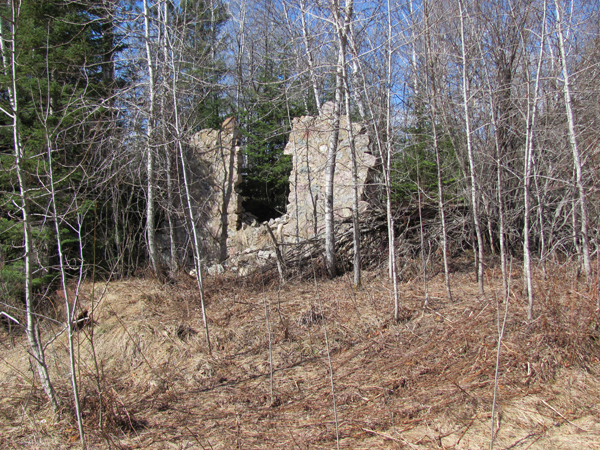 This photo is of the Last Wall of Zenith Sibly Savoy Mine’s Dynamite Shack. It reportedly had 2 foot thick walls and a 10″ thick solid oak door that would have hung in the opening in this wall. The mines shared this shack for safe storage of that vital component of their work. This is all that’s left. So just what town are we going to be?
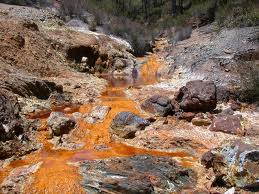 It appears very little is different. The lack of responsibility on the part of large, politically favored heavily financed mining corporations is the same in Utah and Minnesota. You will also see these same battles in any state where you see these corporations systematically pursuing natural resources without sincere and adequate protection for the environment and the health of the states residents. While reading this article by Ms. Udell certain similarities between our states and the “mining situation” struck me as identical, those I’ve highlighted by making the text bold