Etiam pulvinar consectetur dolor sed malesuada. Ut convallis
euismod dolor nec pretium. Nunc ut tristique massa.
Nam sodales mi vitae dolor ullamcorper et vulputate enim accumsan.
Morbi orci magna, tincidunt vitae molestie nec, molestie at mi. Nulla nulla lorem,
suscipit in posuere in, interdum non magna.
There are many serious and legitimate reasons why environmentalists, resort owners, and local residents are worried about the prospect of multiple copper/nickel mines here. I can’t understand why our elected representatives for the most part just give lip service to our concerns while working to expedite a hasty permitting process.
But, EVEN IF there were a foolproof guarantee of no toxic acid leakage… and EVEN IF the mining corporations were to promise that at least half of their hires would be folks with local roots… and EVEN IF the extracted precious metals were not exported to foreign buyers but were guaranteed to be kept locally and in the US, for value-added new industries and jobs… and EVEN IF the mining corporations were truly committed to correcting infractions rather than simply paying fines as part of the cost of doing business their way…
EVEN THEN many of us fear the consequences of letting the genie out of the bottle! Why? Because once the precedent is set, there will be constant pressure to expand, to sell off more mineral rights, to permit new mining operations. Because there are no guarantees against human error (think Exxon Valdez) or the consequences of ever-increasing natural disasters (as in the devastating flooding in Duluth last year). Because the huge electric power needed to operate these mines may require new coal-burning plants that will threaten our air quality. Because many thousands of acres would be lost for wildlife habitat, berry picking, hiking, hunting, birdwatching. Because the noise, the trucks, the lights at night, the heavy industry of multiple mining operations just southeast of Ely would change the character of this place.
This is the edge of the BWCAW! We are stewards of a national treasure, a hugely popular destination, a rare place where lives are changed. Ely is on a roll (compared to other small towns!) precisely because of the creation of the BWCAW: the pristine lakes and fresh air, the quiet and beauty, the rich variety of outdoor activities in all seasons. Our community is bustling with festivals, concerts, special events, and tourists. The Ely Elementary School is experiencing a growth in enrollment. These are some of the reasons more and more of us, young and old, are choosing to settle here, to spend locally, to support our community and school. Our envious friends from noisy, congested places come to visit us; we take them on memorable adventures, show them the stars; they take us out to supper, purchase lures and winter clothing and local art — and buy gas for the long drive back to their cities…
Non-ferrous mining presents a very real threat to the way of life many of us love. Just because precious metals have been discovered under this precious landscape doesn’t mean that we are obliged to let (foreign-owned) corporations make big profits by digging them up.
The Bible harshly criticizes Esau, who, because he was hungry, traded his birthright, his inheritance, for a single meal (Genesis 25:29-34; Hebrews 12:16). Let’s not make the same mistake of selling out our future for the sake of short-term economic gain!
How is it possible that the Wisconsin legislature is ready to pass legislation to create fast-tracked, less-protective ferrous (iron) mining laws for what promises be the largest open-pit iron mine in the world with no scientific evidence to justify treating iron mining differently than other metallic mining?
If Gogebic Taconite proceeds with a proposal, its first phase of mining alone would be larger than the acknowledged largest iron mine in the world, the Hull Rust Mahoning Mine in Hibbing. The taconite ore body in northern Wisconsin is known to run 22 miles, meaning the expansion of mining after phase one could result in an even larger mine with more potential to destroy rivers, streams, wetlands and groundwater.
The main proponents of an iron mining bill in Wisconsin — including Gogebic Taconite, Wisconsin Manufacturers and Commerce and the Wisconsin Mining Association — have misled legislators with claims that the iron ore in Ashland and Iron counties is more environmentally safe compared to metallic sulfide mining and thus requires separate regulations.
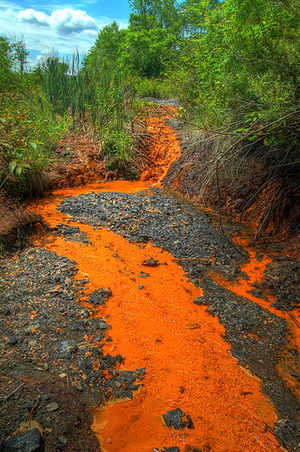
Mining proponents claim taconite ores do not contain sulfide minerals such as pyrite, which can produce acid mine drainage and poison local water supplies with dissolved toxic metals such as mercury, arsenic and lead. This claim is false. The Wisconsin Geological Survey reported as long ago as 1929 that pyrite is associated with the ore and waste rock. The United States Geological Survey reported the same thing in 2009. Huge amounts of sulfide-bearing minerals must be extracted to get to the deposit and would be discarded as waste.
Gogebic Taconite has yet to release information on the geochemical content of the ore it hopes to mine. Mike Wiggins, tribal chairman of the Bad River Band of Lake Superior Chippewa, recently called on Gogebic Taconite to release this information so we can publicly discuss whether the projected 910 million tons of waste over
35 years of phase one, stored at the headwaters of the Bad River watershed, could produce the same acid mine drainage that resulted in fish advisories for mercury and a wild rice dead zone for 100 miles downstream from Minnesota’s Mesabi Iron Range in the St. Louis River watershed.
While proponents claim taconite mining in neighboring Minnesota and Michigan has clean track records, the facts suggest otherwise. A survey of compliance records from 2004 to 2012 for taconite mines and related production facilities in Minnesota and Michigan shows all 10 modern taconite mines and processors are chronic polluters with fines and stipulations of more than $2.1 million (see wisconsin.sierraclub.org/
PenokeeMine.asp). A Minnesota DNR report in 2003 found taconite mining to be the second-largest source of mercury emissions after coal power plants. The study also reported that no suitable technology has been found to curtail taconite mercury emissions.
Gogebic Taconite’s claim that ferrous (iron) mining should be regulated separately seems based on an artificial distinction without scientific merit. Legislators who voted in support had to have been deliberately misled by Gogebic Taconite, Wisconsin Manufacturers and Commerce and the Wisconsin Mining Association about the safety of taconite mining. Their votes had to have been based on unproven mining industry rhetoric over scientific fact.
The failure to admit the presence of sulfide minerals in the waste rock also has reinforced an attitude among some legislators that the concerns of the Bad River Band do not have to be taken into account in the legislative debate. These legislators need to be reminded that the treaties between the Lake Superior Chippewa and the federal government affirm tribal rights to hunt, fish and gather wild rice in the ceded territory of Wisconsin, Michigan and Minnesota. The Bad River Band also has sovereign authority, under the Clean Water Act, to protect its wild rice from mining pollution. Legislation that conflicts with the treaties or the tribe’s sovereign authority will be subject to lengthy court challenges and grassroots resistance from an Indian, environmental, sport-fishing and conservation alliance that defeated the Crandon mine in 2003.
By: Al Gedicks and Dave Blouin, for the Duluth News Tribune
Al Gedicks of La Crosse, Wis., is executive secretary of the Wisconsin Resources Protection Council and the author of “Resource Rebels: Native Challenges to Mining and Oil Corporations.” Dave Blouin of Madison is the Mining Committee chairman for the Sierra Club-John Muir Chapter of Wisconsin and is co-founder of the Mining Impact Coalition of Wisconsin.
Iron Range Politicians demand fealty* from St. Louis County Board regarding a BWCA and Superior Nation Forest land swap to benefit Copper mining in Northeastern Minnesota, all their subterfuge aside.
* (An oath of fealty was a fundamental element of the the feudal system in medieval Europe . It was sworn between two people, the obliged person (vassal) and a person of rank (liege lord).
In a meeting intended for business so urgent that it cannot be delayed till the next meeting on January 8th, St. Louis County Commissioners passed a resolution that weighs in on an issue that has been highly controversial to citizens in St. Louis County, Minnesota and indeed the entire nation for more than 30 years. The only urgency was to avoid the voices of the public weighing in on an issue that has kept public policy makers from taking action for decades.
This version is “only” 30 minutes long and was condensed from the original 2 hour 15 minute segment dedicated to the Land Swap. It doesn’t take a professional psychologist to see the distinct split between fact finders and fact avoiders, between those stuck in a 19th Century industrial revolution model of economic development and those desiring a cleaner healthier existence with their jobs. Enjoy! This is pure Iron Range Politics and coercion as only someone who has lived on the Iron Range can understand. But, if you delve into this video, you also will understand a major part of Iron Range Politics. We have included the full version also, should you want to see EVERY nuance of the event.
Full version of the BWCA Land Swap session
In reality less money would be made for Minnesota’s schools with the politicians plan than a plan proposed by citizens at this meeting. A proposal that was completely ignored by the board.
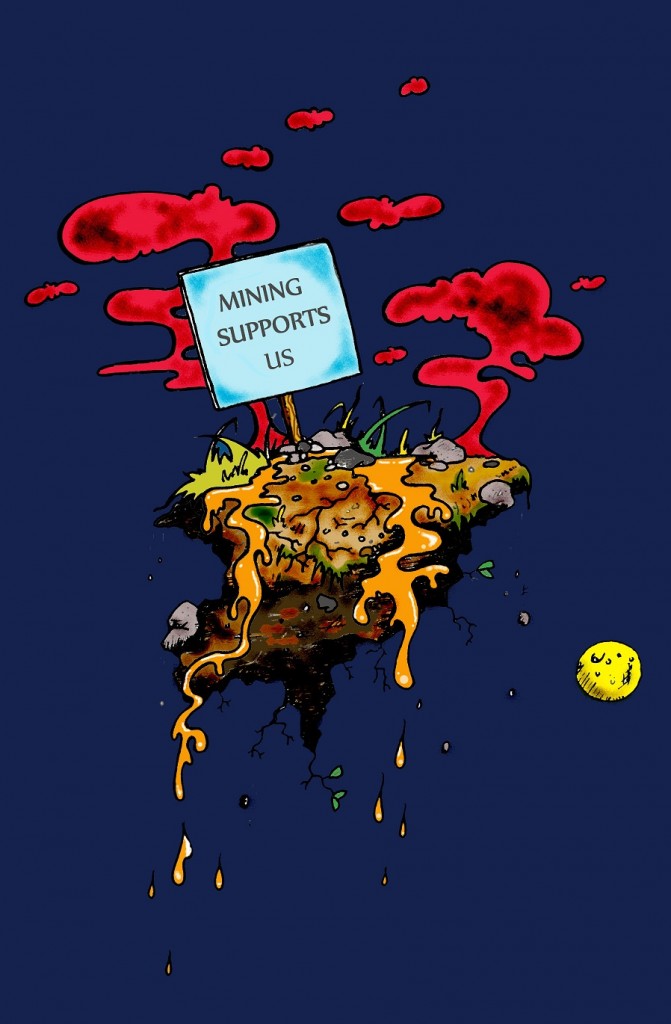
Yes Virginia, some only see the meager gifts this Santa brings. They over look the arsenic, mercury, and acid mine drainage that comes with this type of mining. They over look the “resource curse,” the bad behavior of the industry, and the propaganda fed them by their elected officials. Yes, this blind neglect of fact and reality, is quite strange human behavior. But, so is an adult believing in Santa Claus. Sulfie, and the wild rice he used to swim in KNOW!
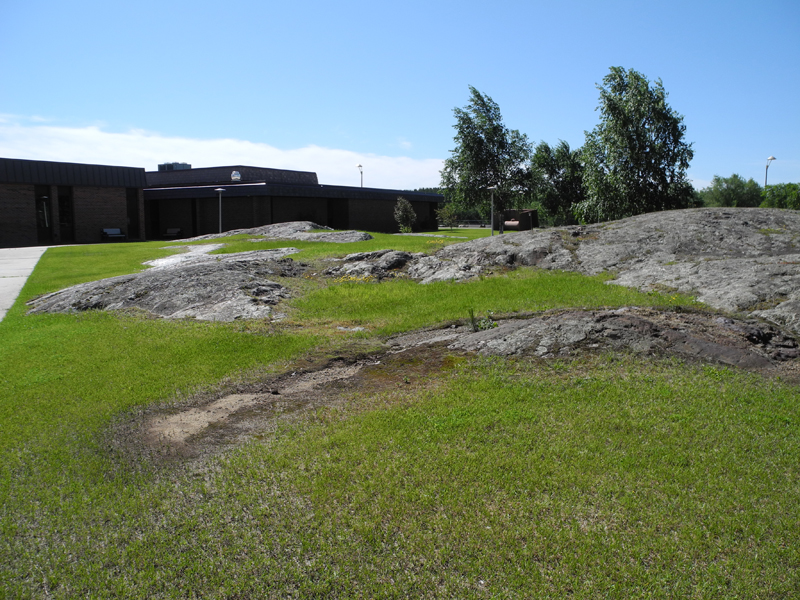
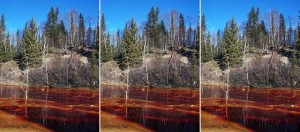
Vermilion Community College (VCC) in Ely, MN offers an excellent example of the bad results from water runoff of exposed rocks containing sulfur. A very thin band of exposed sulfur containing rock in the Greenstone outcropping in the VCC courtyard has produced a dead zone “downstream.” As you approach the massive Greenstone outcropping from the front of the courtyard you see what we would expect in Northern Minnesota, bright green vegetation, flowers, a healthy Birch Tree and a huge rock outcropping. Hidden from view, on the backside of this larger outcropping, is a smaller outcropping that contains a small thin band of exposed crumbly sulfurous rock that has, with rain running off and “downstream” from this rock, a dead zone where nothing lives, except the rocks. Although this is not the same kind of rock that will be mined for copper, sulfur in what ever form when exposed to air and water will produce acid mine drainage and release of arsenic and mercury and other heavy metals into the watershed and that DOES include the type of rock that contains sulfur in the form of sulfides that may be mined for copper in our region.
What we want to see
First View of the Problem
You will notice, below, that a small pine tree is able to grow on slightly higher ground where the rain runoff doesn’t reach.
The Sulfurous Culprit
View of the Sulfurous rock runoff zone
Closeup of the Dead Zone caused by runoff from the Sulfurous Rock
ELY, Minn. — A pro-mining stance combined with a pro-environment stance, which everyone claims they desire, demands nothing less than a “prove it first” law in Minnesota. “Prove it first” is the obvious and only conclusion that permits mining and saves the clean air and water we all love and need.
For Minnesota politicians or residents to accept or promote anything less than “prove it first” with parameters similar to the Wisconsin law in regard to non-ferrous sulfide mining in Minnesota is to be one of the following (or perhaps all three):
Misinformed: Many still don’t know the difference between iron mining and non-ferrous sulfide mining. Why do politicians rarely distinguish between the two entirely different processes? Many believe in the hype and promises of this non-ferrous mining industry with a significantly less-than-stellar reputation. They believe in the myth of “strong regulations” of the mining industry in Minnesota. Some co-opted politicians believe the existing wild rice protective limits for sulfates were “arbitrarily” chosen, when in fact the research establishing the existing limits was performed by one of our DNR’s best scientists, who had the absolute respect of his colleagues. That field research was done when our waters were less polluted than they are now; therefore it was more reliable than if done today in more polluted waters or in a laboratory.
Disingenuous: This includes those claiming to be for clean water but doing nothing to guarantee such. And, there is no guarantee in promises, inadequate financial assurances or unproven new technology.
Intellectually dishonest: Do we not have enough polluted water (and increasing at every count)? Have we not coddled the mining industry sufficiently, to our own detriment? My research indicates that Minnesota is not protecting Minnesotans and our water, partly because of inadequate regulations but more often because of inadequate enforcement. Those of us who have been labeled hard-headed environmentalists by U.S. Rep. Chip Cravaack and state Rep. Tom Rukavina are at odds with the intellectually dishonest who are demanding faster tracking to disaster and land swaps that are blatantly unfair to Minnesotans. Why would we trade lands that are protected by the Weeks Act for unprotected lands? The claim that the BWCA land swap bill H.R. 5544 is for the poor children is intellectually dishonest. If it were so important, you would think these stalwart politicians would have demanded to settle this land issue for the children years ago. But now that Polymet Mining and other mining interests want these lands, the children’s interests surface more prominently.
Iron Range politicians and mining companies dislike the analysis brought to the current situation by the researched and documented “resource curse.” In essence, if mining is so great and supposedly we are in record times for taconite production, why are Iron Range communities in such bad economic shape? You would think communities would benefit along with the mining companies, but the research indicates that communities are worse off with mining than without.
An article from Mining Watch Canada shows how the mining industry is questioning the “resource curse.” The International Council on Minerals and Metals has determined the problem is with poor governance of host countries. First mining companies co-opt all levels of governance for minimum regulations, favoritism at all levels and the best terms and taxation, then they blame the host country for not striking a better deal, not managing revenues and not investing in social causes or benefit sharing, particularly at the local level (the ICMM’s words, not mine). So, mining companies are responsible for nothing except their profits. And in part that is true. In the U.S. they are legally bound to maximize shareholders profits. If they decide to become socially conscious and that costs money, shareholders could sue them for not maximizing profits. It should therefore fall on governments, the supposed representative in the service of the people, to demand the best possible “deal” for their citizens, in this case the residents of Minnesota.
THEREFORE: Prove it first! If mining companies prove their technologies will not pollute Minnesota air and water, let them have the minerals they desire. And, to Minnesota politicians at all levels of governance: Strike the best deal you can for all the residents of Minnesota, for the health and wealth of Minnesota. Be informed, and more important, keep us informed.
Be genuine in your dealings with us; we see right through the disingenuous. We don’t need any more governmental “listening sessions”; we need dialogue and governmental transparency.
Many words have been exchanged regarding the exchange of Minnesota trust fund lands that remain within the Boundary Waters Canoe Area Wilderness (BWCA). Politicians are lamenting the fact that these lands have not been able to generate money for the school trust fund through mining, logging, or leasing, and that this is an insult to all of the school children of the state.
As a matter of clarification, the state Constitution specifies that the Permanent School Fund must be managed for “maximum return,” not that the land itself must produce income. If anyone makes money on school trust lands, the money must then be used to benefit the fund. To draw from this interpretation, the Permanent School Fund (PSF) should have received a percentage of U.S. Forest Service BWCA permit fees. Such a recreational fee was suggested in the 1990s, but rejected by Iron Range legislators, who instead wanted a land exchange in order to more aggressively log what is now Superior National Forest.
Also as a matter of clarification, the majority of school trust lands were sold by the early 1900s for agriculture and development. The PSF is now worth $750 million. Interest from the fund generates $26 per student, out of approximately $9000 allocated (state general fund, property taxes, Federal dollars) per student per year. The PSF contributes less than .3% per student.
In northeast Minnesota, much of the school trust lands are wetlands, forest, or designated Swamp Lands, which were never meant to generate money for the trust fund. While logging, leasing, land sales and iron mining have added to the fund over the years, a new type of mining dominates political discourse. Multinational mining companies are exploring the entire Superior National Forest, between Lake Vermilion and the North Shore, for previously unmarketable low grade copper-nickel sulfide mineralization. Despite the fact that mining of these sulfide ores would leave behind a trail of acid mine drainage, heavy metal pollution, and 99 percent waste rock, politicians grasp onto mining company projections of the financial benefits to the state while ignoring the long-term consequences and costs of perpetual water treatment and extensive and persistent pollution.
Jumping on the land-exchange bandwagon
If state land within the BWCA can be exchanged for federal land in Superior National Forest, that land loses many of its federal protections — including the Weeks Act, which prohibits open pit strip mining; the Endangered Species Act; and other laws. This would facilitate the opening of a sulfide mine district within what is now Superior National Forest.
In 2012, the Minnesota Legislature passed SF 1750, which includes language enabling the federal government to proceed with a land exchange. Eighth District Rep. Chip Cravaack then introduced H.R. 5544, the Minnesota Education Investment and Employment Act. This bill authorizes a complete land exchange of the state lands held within the BWCA. It also incorporates language from SF 1750 giving priority to land that provides the most opportunity for revenue generation from mining.
H.R. 5544 bypasses and ignores Native American tribal rights and is contrary to laws, policies, and executive orders requiring government-to-government consultation on concerns related to federal actions. The land exchange details are being developed without public participation. The bill specifically nullifies the National Environmental Policy Act (NEPA) regarding the transfer of public lands, which includes environmental review, public input, and the right to legal challenges. It gives no voice to local concerns regarding mineral exploration on private lands, the concerns of those seeking to protect their jobs and property values that depend upon recreational use and scenic quality of Superior National Forest, and those seeking to protect the watersheds of Lake Superior and the BWCA.
Severed mineral rights
Cravaack’s bill also ignores the fact that many of the federal lands have severed mineral rights owned by private mining interests, and therefore will not generate money for the school trust if exchanged. Nor does the bill solve the problem of the state’s severed mineral rights that would remain within the BWCA; these mineral rights could generate further exchanges and the further dismantling of Superior National Forest.
The sole intent of the proposed land exchange is to facilitate the opening of a sulfide mining district on lands bordering the BWCA and extending through what is now Superior National Forest to Lake Superior. Without the stated motive of generating revenue for the trust, there would be no need for a land exchange.
During the late 1990s, the entire Minnesota federal delegation supported a complete land sale of state trust lands within the BWCA to the federal government, with money available from the Land and Water Conservation Fund. This would have generated money for the PSF without dismantling Superior National Forest. This proposal fell apart due to opposition from Iron Range legislators who wanted to create jobs through more aggressive logging; the result was neither jobs nor money for the school trust. The same legislators are now willing to trade off both logging and recreational jobs for some speculative number of potential mining jobs in ores of marginal marketability.
H.R. 5544 leads the way for other land exchanges. Such is the case with PolyMet, whose proposed copper-nickel open pits, though not on school trust land, would lie upon what is now Superior National Forest. According to U.S. Forest Service comments in PolyMet’s Draft Environmental Impact Statement, “It is the position of the United States that the mineral rights reserved … do not include the right to open pit mine the National Forest lands.” PolyMet would thus need special legislation removing current environmental protections in order to open a strip mine on public land.
H.R. 5544 must have a companion bill in the Senate in order to pass both houses of Congress. It remains to be seen whether Sens. Al Franken and Amy Klobuchar will ignore public sentiment and go along with the give-away of Superior National Forest to multinational mining corporations, who will in turn outsource our metals on the global marketplace.
When all is said and done, politicians secretly negotiating land exchange deals will be out of office by the time the true impacts of their legacy becomes apparent. The loss of our public heritage and the burden of toxic pollution and perpetual treatment will rest upon tomorrow’s schoolchildren.
The U.S. Forest Service motto is “Caring for the Land and Serving People.” Its mission is, “to sustain the health, diversity, and productivity of the Nation’s forests and grasslands to meet the needs of present and future generations.”
“Future generations” does not mean the 20-year lifespan of a sulfide mine. After minerals are mined out, surface resources are also depleted; harvestable trees no longer grow, wetlands are buried or full of heavy metals, and fish in affected lakes and rivers are unsafe to eat because of mercury and sulfate levels.
When did the Forest Service forget the founding intent of the agency? According to “The Forest History Society,” the first Forest Service Chief, Gifford Pinchot, had a “great and unrelenting concern for the protection of the American Forests.” It was Pinchot who used the phrase “in the long run” in order “to emphasize that forest management consists of long-term decisions.”
The Forest Service of today pretends that the inherent intent of “minerals exploration” is not to mine the land, at the same time that sulfide-mining companies are announcing their intent to mine. The Forest Service pretends the outcome of such mining is not the destruction of renewable forests, wild rice, and surface water resources – all for the extraction of non-renewable minerals.
Clear and unclear language
Sulfide mining companies are drilling hundreds of boring holes connecting and carrying contaminants through our aquifers. On May 18, Acting Forest Supervisor Timothy A. Dabney said in the cover letter of the Federal Hardrock Mineral Prospecting Permit EIS, Record of Decision: “I appreciate that there are strong feelings about minerals management on the Superior National Forest. I understand that there are concerns about impacts to natural and social resources on the Forest and to the Boundary Waters Canoe Area Wilderness (BWCAW). I also understand there is interest in the benefits from economic activity associated with minerals exploration.”
Dabney used specific and positive terms, “benefits from economic activity,” to describe the mining position, but non-specific and unclear language to express the numerous critical issues regarding the environmental, public health and economic impacts of mineral exploration; hardly reflective of the “strong feelings” that do exist. If Dabney had used an antonym of “benefits” such as ”harm, loss, damage, injury, or impairment” to frame specific impacts associated with minerals exploration, he may have achieved some balance.
The single item Dabney selected in his cover letter for “a hard look,” is noise impacts from the drilling, which, while important, pale in comparison to the environmental, health and long-term economic issues that deserve a “hard look.”
Minnesotans need proof, not mythical thinking
On May 31, during the Minnesota Executive Council meeting at the State Capitol, the messaging had a similar tone when the council decided to approve its postponed sale of 77 exploratory mineral leases:
“This is about exploratory drilling.” “It is not about mining.” “If you deny the mineral lease sales it will send a message to investors that Minnesota is not mining friendly.” Anyone else see the contradiction?
I came to the conclusion that our agencies are not going to protect our waters because political appointees have an agenda unlike those working in the ranks. The majority of our legislators are not going to protect our waters because corporations lobby with massive amounts of money. Our Executive Council is not going to protect our waters because it is uniformed or misinformed. Not one member mentioned the fact that no matter how much money is put into a “superfund” for cleanup, it has been proven time and time again that financial assurance has been inadequate for sulfide-mining “remediation” —which, by the way, is not the same thing as cleanup.
Not one council member mentioned that Minnesota has been unable to clean up its polluting taconite mines. And no one asked the most important question. What if contamination from sulfide mining cannot be cleaned up? The Executive Council said it could not make decisions based on “what ifs,” but the entire pro-sulfide-mining campaign is based on a mantra that it can be done safely, the biggest “what if” of all.
Guilt is a powerful tool of manipulation
“We all use metals.” A message repeatedly used by members of the Executive Council, and campaigned on by mining representatives as the reason we should sacrifice our waters. “We all use metals” is a true statement used for the wrong reason. The United States has long been oblivious to its gluttonous use of the world’s resources, an attitude Minnesota mining is encouraging – and exploiting – rather than being drivers for change. Remember their fat-baby cartoon showing all the metals a baby devours in its lifetime? Not only is it shocking, it also lacks any mention of conservation possibilities. It is strictly an industry self-serving ad for consumption.
“Copper has an infinitely recyclable life … . Each year in the U.S.A., nearly as much copper is recovered from recycled material as is derived from newly mined ore. … The U.S. does not depend on foreign copper … we are completely self-sufficient.” (Copper Development Association Inc.)
You would never know it after listening to the sulfide-mining lobbyists in Minnesota. These are the same folks who hid the fact that our metals would be sold on the open market, while simultaneously expounding on “national security” as their rationale for mining.
Rep. Carly Melin is still spreading the lie, “Those [our minerals] are things that China cannot take away from us, no matter how hard they try,” Melin said at the Minnesota Democratic Convention (Alexandria Echo Press).
If our minerals are mined – unless it is outbid – China already has them.
Minnesota’s legacy
The Iron Range has a proud mining heritage, a message reiterated by the Executive Council. That does not mean northern Minnesota cannot choose a different heritage for its future – without denigrating the past of the Iron Range. From time immemorial countries and people have reinvented themselves.
What we face today is a decision about whether to allow sulfide mining in water-rich Minnesota, one of the worst places on the planet to experiment. The idea that Minnesota has to choose a “balancing act” between water pollution and mining is a sell-out of our waters. And us. It also does not address water usage, another sell-out: Minntac alone “needs ten times as much water each day as the greater Duluth area” (U.S. Steel). What astronomical amount would the proposed sulfide-mining projects add to that load, to the contaminated waters released?
The best thing Minnesota could do for itself, and the rest of the world, is to hold sulfide-mining companies accountable by enacting prove-it-first legislation. All of us could start focusing our attention on attracting jobs that preserve our wealth of water – companies that will add to our quality of life, not extract our health along with our metals.
Our children were forgotten
It angers me, when considering the Hardrock EIS and the Executive Council meeting, that no one in positions of power seriously considered the looming health impacts to our children from proposed sulfide mining. It is always about money and a comparatively small number of jobs in a rapidly automating industry.
How much is a damaged child worth? Mining companies in the 1970s and 80s did such calculations. When faced with faulty equipment at Bunker Hill, corporative board members calculated how much they would have to pay per damaged child based on a similar Texas lawsuit, decided it was worth it to continue mining, reaped their millions, and then paid a pittance to some Idaho families – whose children were among hundreds of children poisoned.
Are we not doing the same thing, minus the actual calculations? We already have 10 percent of newborns in the Lake Superior basin with toxic levels of mercury in their blood. The Lake Superior basin includes the Iron Range, its taconite mines, and the coal-fired power plants that run them. Operating on variances, they spew sulfates into our waters to orchestrate mercury methylation. Methyl mercury is the toxic form of mercury that bioaccumulates in fish, in us when we eat fish, and in our unborn babies. Taconite mines are the biggest source of sulfate pollution in northern Minnesota. Think of the implications for proposed sulfide mining. Our babies are the canaries of the mining industry, and we are ignoring the ramifications.
We tell expectant mothers not to eat fish, blaming the victims. Pat McCann, the research scientist who conducted the study for the Minnesota Department of Health and the Environmental Protection Agency, reportedly said, “Babies don’t eat fish” (Star Tribune). We have all been conditioned to avoid mercury-laden fish, to keep our children inside when air pollution is high, and to protect them from any number of environmental toxins. Wisely — but the message is that we are to blame if we do not. Corporations releasing the toxins have denied their responsibility, shifted the blame, and we let them get away with it. We have a right to clean air, a right to eat the fish we catch without damaging our unborn children, and a right to demand protection.
Back to the future
Which ironically brings us back full circle, back to the beginnings of the Forest Service. Pinchot “served as chief with great distinction, motivating and providing leadership in the management of natural resources and protection of the national forests. He continued as forester until 1910, when he was fired by President Taft in a controversy over coal claims in Alaska” (The Forest History Society).
Today, we know the effects of coal mining and coal-fired electricity on the health of all of us, especially our children. We cannot plead ignorance, or use the semi-truth of “it was another era” to excuse mining industry practices that cause pollution. We also know that the sulfide mining record of today is dismal.
So ask yourself, “How much is my child worth?”
This article was first published in MinnPost 06/25/12
Take Action – Call Senators Franken and Klobuchar to Stop the Land Swap!
Recently, Rep. Cravaack introduced H.R.5544 to expedite the exchange of an unknown amount of federally-protected Superior National Forest land for 86,000 acres of state school trust lands contained within the BWCA. If passed, this legislation would open tens of thousands of acres of wildlife habitat to new toxic sulfide mining proposals and other development. Federal ownership carries with it a variety of critical legal protections, and all of these important safeguards would be lost on any National Forest land included in this exchange. In addition, the bill bypasses environmental review and public involvement.
Then, let us know you made the call!
Senator Franken: (202) 224-5641 and (651) 221-1016
Senator Klobuchar: (202) 224-3244 and (612) 727-5220 Learn more and send a letter here, and thanks for taking action today.

 How is it possible that the Wisconsin legislature is ready to pass legislation to create fast-tracked, less-protective ferrous (iron) mining laws for what promises be the largest open-pit iron mine in the world with no scientific evidence to justify treating iron mining differently than other metallic mining?



 ELY, Minn. — A pro-mining stance combined with a pro-environment stance, which everyone claims they desire, demands nothing less than a “prove it first” law in Minnesota. “Prove it first” is the obvious and only conclusion that permits mining and saves the clean air and water we all love and need.
 Many words have been exchanged regarding the exchange of Minnesota trust fund lands that remain within the Boundary Waters Canoe Area Wilderness (BWCA). Politicians are lamenting the fact that these lands have not been able to generate money for the school trust fund through mining, logging, or leasing, and that this is an insult to all of the school children of the state.
 Take Action – Call Senators Franken and Klobuchar to Stop the Land Swap!