Etiam pulvinar consectetur dolor sed malesuada. Ut convallis
euismod dolor nec pretium. Nunc ut tristique massa.
Nam sodales mi vitae dolor ullamcorper et vulputate enim accumsan.
Morbi orci magna, tincidunt vitae molestie nec, molestie at mi. Nulla nulla lorem,
suscipit in posuere in, interdum non magna.
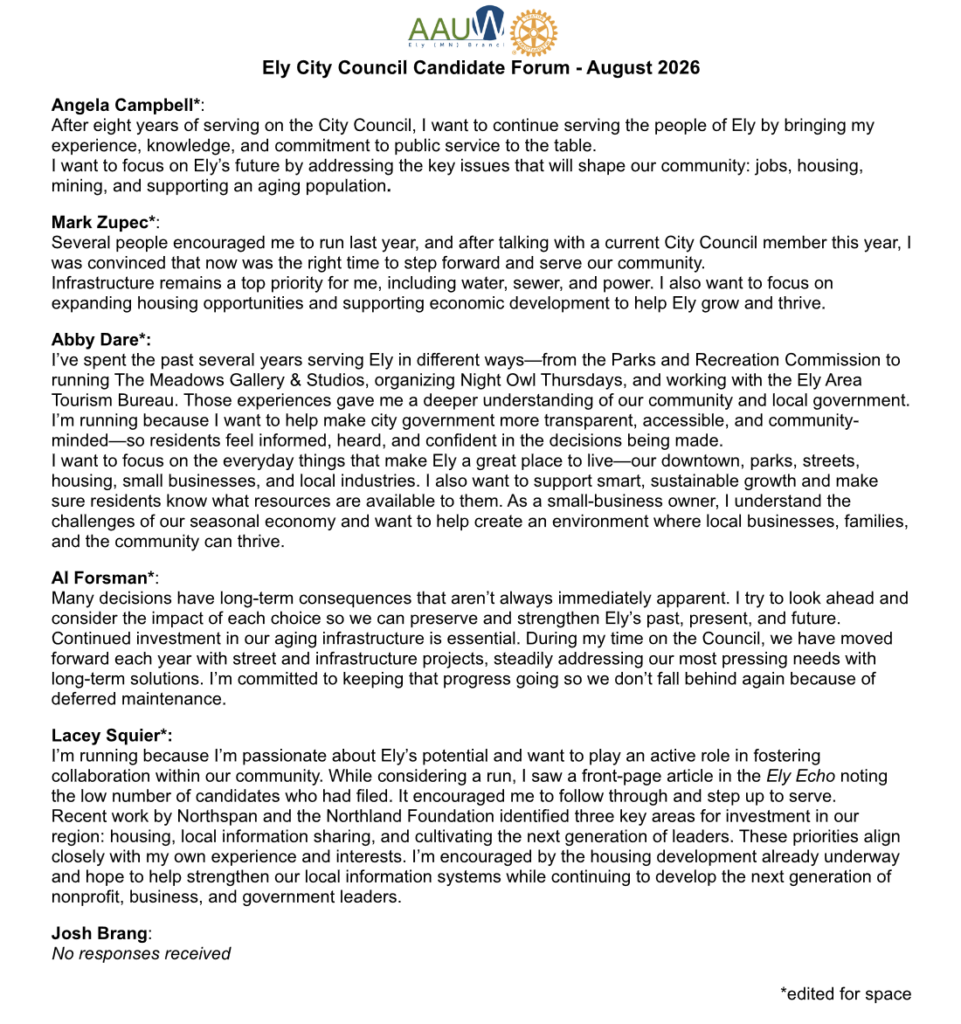
The Ely Branch of AAUW and the Ely Rotary Club hosted an Ely City Council candidate forum on September 10, 2026, at the Ely Vermilion Campus. This is a nonpartisan election.
City Council Candidates seated left to right: Josh Brang (absent), Lacey Squier, Al Forsman, Abby Dare, Mark Zupec, and Angela Campbell.
Candidates’ statements (below) were submitted to and printed out by AAUW/Rotary, and then given to audience just before the forum started. Statements were edited for space reasons. Scroll down to read their statements.
Note: AAUW/Rotary hosted the Ely Mayoral Candidate Forum earlier tonight. Watch on YouTube https://youtu.be/3fqmQ-pGqyc
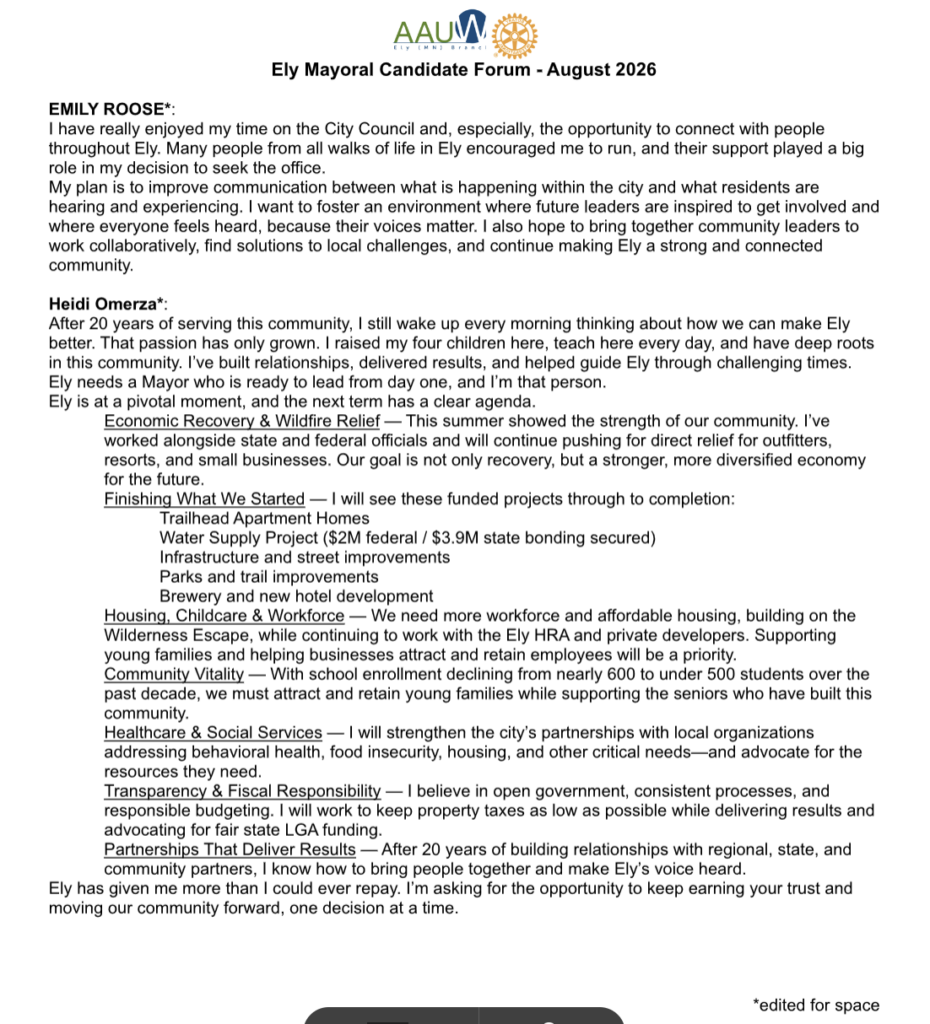
The Ely Branch of AAUW and the Ely Rotary Club hosted a mayoral candidate forum on September 10, 2026, at the Ely Vermilion Campus. Incumbent Heidi Omerza is being challenged by Emily Roose. This is a nonpartisan election in Ely, MN.
Note: after the Mayoral candidate forum tonight, AAUW/Rotary held an Ely City Council Candidate forum. Watch at https://youtu.be/7i2vovmPI2w
Candidates’ statements (below) were submitted to and printed out by AAUW/Rotary, and then given to audience just before the forum started. Statements were edited for space reasons. Scroll down to read their statements.
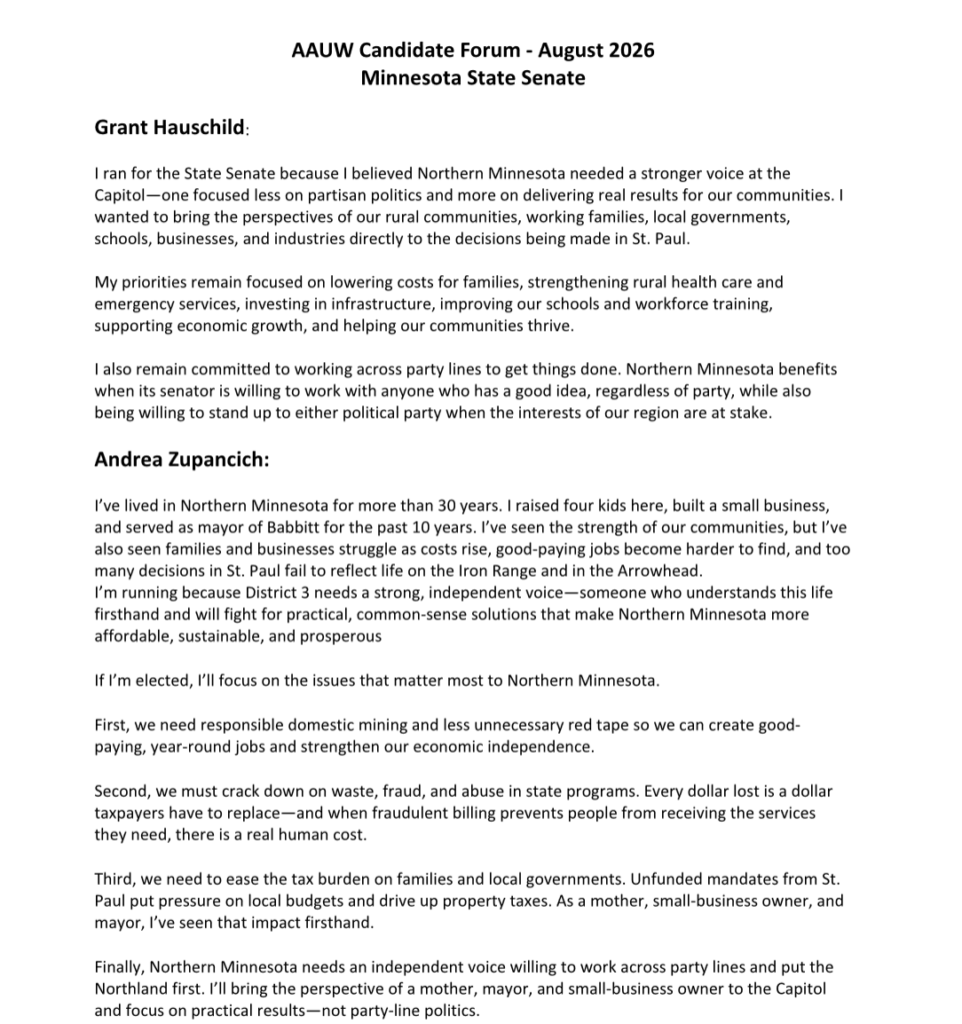
The Ely Branch of AAUW and Ely Rotary Club hosted a Minnesota Senate District 3 candidate forum on September 2, 2026, at the MinnesotaNorth College’s Vermilion Campus. in Ely, MN.
Incumbent Senator Grant Hauschild (DFL) is being challenged by Andrea Zupancich (GOP).
For information about MN elections on November 3, 2026 go to the Minnesota Secretary of State website https://www.sos.mn.gov/elections-voting/
Candidates’ statements were submitted to and printed out by AAUW/Rotary before the forum, and then given to audience before the forum started. Both statements were edited for space reasons.
The Ely Branch of AAUW and the Ely Rotary Club hosted a Minnesota House District 3A candidate forum on September 2, 2026, at the MinnesotaNorth Colege’s Vermilion Campus in Ely, MN.
Incumbent Roger Skraba (GOP) is being challenged by Aaron Kania (DFL).
Candidates’ statements (below) were submitted to and printed out by AAUW/Rotary, and then given to audience just before the forum started. Both statements were edited for space reasons.
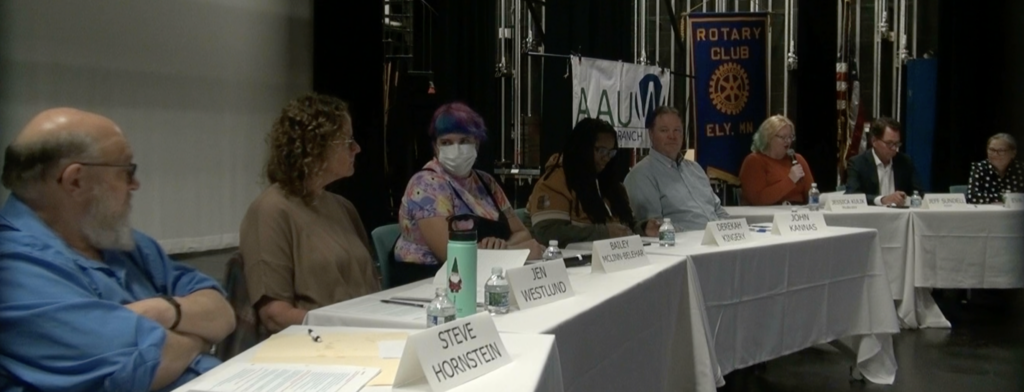
(left to right): Steve Hornstein, Jennifer Westlund (incumbent), Bailey McLinn-Belehar, Derekah Kingery, and John Kannas
Scroll down to watch YouTube video
The Ely Branch of AAUW and the Ely Rotary Club hosted a School Board Candidate Forum on September 30, 2026, at MinnesotaNorth College’s Vermilion Campus in Ely, MN.
The Ely School District #696 school board election is nonpartisan. Voters can vote up to 3 candidates (for 3 seats). For more info about MN elections on November 3, 2026, go to the MN Secretary of State website www.sos.mn.gov/elections-voting.
Seating of candidates (left to right): Steve Hornstein, Jennifer Westlund (incumbent), Bailey McLinn-Belehar, Derekah Kingery, and John Kannas. Joe Weise did not attend the forum.
All 6 school board candidates submitted statements to AAUW/Rotary. They were printed out and then given to the audience before the forum began. Statements were edited for space reasons (to fit on one 2-sided page). Note: YouTube only allows for maximum 5000 characters in the description box, so statements could not be posted with YouTube clip.
Call or email candidates directly if you have questions and/or comments.
The following contact information is posted on the MN Sec of State website:
Log on to the MN Secretary of State website to double check YOUR actual August 11th primary ballot. Minnesota House and Minnesota Senate elections do not follow county or city lines. U.S. Congressional Districts do not follow county or city lines. When you type in your address, you’ll find your polling place.
Check your local government for information about where and when to vote on August 11th or how to vote absentee. If you are not 100% certain where you’ll be on Tuesday, August 11th, consider voting by mail or voting absentee. There are several close party races on August 11th, because some individuals are challenging the GOP and DFL endorsed candidates. Your vote could be the deciding vote. Scroll down to find out who the (major) party endorsed candidates are.
We are not going to post instructions here on how to vote by mail or absentee ballot. You need to contact your local election officials.
Does your local government really encourage voting and voter education?
Our democracy exists because most people continue to vote. Don’t let others decide for you.
Chances are, if you’re reading this, you yourself educate others about voting and candidates. Shouldn’t your local government educate others too and in a objective nonpartisan way? Government websites can discourage voting by posting insufficient, misleading and outdated information.
Why aren’t government officials doing more on their websites to highlight the August 11th primary elections? How to vote in person, by mail or absentee? Post sample ballots? Run for office? Or at the very minimum, provide links to important information?
If you don’t like what you see on the websites, contact them (your local government). When you look over these different websites, think about how helpful – or not – they are to folks who just moved to the area. How quick and easy is it for you/them to find info about registering, actually voting, and look at a sample ballot?
There might be additional items on the ballot that were not adequately covered in local media. Especially on primary ballots where/when folks could vote on issues, judges, etc. that don’t appear on the November ballot. Don’t be surprised and uninformed when you walk in to vote! Double check.
None of these local government websites mentions school board elections. It appears they also do not have easily spotted links to public school districts or private schools located within the city or township.
On the City of Babbitt website, you have to scroll down the home page for election information. You then click the links to go directly to MN Sec of State or St. Louis County websites. Everything is computerized and “linked out.” No small town touch.
On the Fall Lake Township home webpage, scroll down to find upcoming calendar events. “Primary Elections” is posted for August 11th, but there are no explanations or links for additional info.
Click on Elections on home page menu. You see a pasted 2-page copy of an election judge interest form with a link to the same form on MN Sec of State website.
Sadly, there are no links or detailed information about registering, voting or sample ballots.
To find Ely election info, look the right-to-left scrolling Elections icon on the home page. Or pull down the menu for Government at the top of the homepage.
The City of Ely has extensive information about registering and voting. And links!
If you get an error message when you type in your address, use or do not use abbreviations.
For example, maybe type Rd instead of Road or type out North instead of N.
Please log on to the MN Secretary of State to double check YOUR actual ballot. Minnesota House and Minnesota Senate elections do not follow county or city lines. U.S. Congressional Districts do not follow county or city lines. Not all candidates running for all the offices are on the primary ballots. If there is no contest then
for Babbitt from MN Sec of State website. Type in YOUR address to see YOUR Aug 11th primary sample ballot.
for Fall Lake Township from MN Sec of State website. Type in YOUR address to see YOUR Aug 11th primary sample ballot.
for Morse Township from MN Sec of State website. Type in YOUR address to see YOUR Aug 11th primary sample ballot.
for Ely from MN Sec of State website. Type in YOUR address to see YOUR Aug 11th primary sample ballot.
If you cannot find a candidate’s website after searching on the internet, look for their contact information on the MN Secretary of State’s webpage https://candidates.sos.mn.gov/
To find who’s running for MN governor, secretary of state, etc, selecr “State Executive Offices.” There are other options if you wish to narrow your search.
Click on candidate’s name or website to get more information directly from the candidate. It is up to you to email or call them.
Notice there are indeed 3rd party candidates. It appears nobody in the Green, Independent, Libertarian, or Forward Independence is challenging their endorsed candidates for these races, so they don’t appear on the August 11th primary ballot. They advance to the November 3rd general election.
Select “Federal Offices” for candidates who have filed for U.S. Senate and U.S. House of Representatives.
U.S. SENATE There is no incumbent. This is an open seat. U.S. Senator Tina Smith decided not to run for re-election. DFL endorsed candidate Peggy Flanagan is facing a heavy challenge from Angie Craig who decided to bypass the DFL endorsement convention. YOU will decide the outcome. Research before voting.
U.S. HOUSE There are 8 U.S. Congressional Districts in MN. Scroll down to find CD 8. The DFL endorsed candidate Trina Swanson needs your vote to challenge Pete Stauber. Please also consider donating, volunteering, and getting everyone around you to vote for her on August 11th.
Select “State Senate Offices” for candidates who filed for MN Senator. Grant Hauschild is the incumbent. GOP candidate Andrea Zupancich is again challenging him. This will be close race. The GOP will be pouring money into this race, as they are afraid of Grant Hauschild’s energy, leadership skills, and ability to get things done. Seriously. There is no internal party challenges for a primary, so this office will be on the Nov. general ballot.
Select “State Representative Offices” for candidates who filed for MN House. Scroll down to 3A and 3B. Since there are no challenges within their parties, you won’t see these offices on the August 11th primary ballot. The incumbents are GOP and running for re-election. Both 3A and 3B were extremely close races. What happened? Low voter turnout. YOU will decide the outcome in November. Consider volunteering & donating!
What do YOU know about Minnesota judges & our judicial system?
Take the challenge!
Click on “Judicial Offices.” Do you know which District you’re in? Whom do contact to find out?
Which candidates are incumbents? Why are there challenges (a race, competition)? Why are there so few challenges?
Check back closer to November to see if we posted more info (answers). No promises.
This morning WELY Radio announced an informational meeting at 7 pm, Sunday, July 19th, at MinnesotaNorth, Ely Vermilion Campus.
We cannot constantly update about the emergency situation surrounding this area or meetings. Please go directly to ElyCommunityResponse and your regular websites and sources for updates.
ElyCommunityResponse has received tremendous coverage from respected news sources. Here are some posts with video clips that have shown up after a Google search.
This morning (Sunday, July 19th), WELY radio has made several hourly announcements about tonight’s special emergency meeting to be held at 7 pm on VCC campus auditorium. As of 12:20 pm, this is what appears on the City of Ely webpage, basically nothing about the meeting. Please listen to WELY radio.
Go to websites and WELY Radio with capacity for ongoing updates
Public Notices website https://www.ely.mn.us/notices
This is a group of concerned community folks who stepped up to IMMEDIATELY and unselfishly facilitate assistance and conversation. Volunteer community members like these often best understand the need for urgent proactive action.
Bureaucratic government often forgets the heart and spirit of community and falls into complacency. Enough of politics. No time for politics (and no more accusing). Please go directly to ElyCommunityResponse posted links for more information about how to help and/or be helped.
We are blessed in this area to have such competent and caring leadership for emergencies like we are experiencing right now: Police, fire, emergency medical systems (EMS ), forest service . . . AND . . . county, state and national organizations.
Here’s a sample of informational meeting ElyCommunityResponse held at Ely City Hall that was posted by WDIO TV. This was a community helping community meeting, “community” also meaning forest service, FireWise, firefighters and local experts from city, county, state and national organizations. When you click https://www.wdio.com/top-stories/watch-ely-community-response-information-session/ two video clips will pop up. The first clip is the short news broadcast. The second clip is the hour long meeting. If the links don’t work for you, please search WDIO website directly.
Disclaimer: Citizens for Transparency and this website were not involved in organizing ElyCommunityResponse. We are just relaying information. They are organic, grassroots and evolving. We cannot keep up with all the awesome activities, of this group including orchestration of informative and useful meetings. Please contact them directly!
Scroll down to the bottom of this post to see how City Hall and/or City web designers have suddenly changed the placement of Public Notices on the City webpages, making it even more difficult for the public to access information in a timely manner, info concerning them with a deadline for them to comment.
Please read the details about these 3 BOA Hearings. Many community members are concerned about all 3 and are planning to speak or have submitted comments. Please inform yourselves. We are all concerned about the fires around Ely and our friends, family members, relatives and colleagues dealing with (potential) evacuations. Despite ongoing community concerns about local fires and evacuations, BOA will not reschedule tomorrow’s meetings. BOA rulings are final unless owner appeals to Council. Citizens cannot appeal.
Get as much information as you can about the BOA Hearings
You may or may not find links to additional documents when you open links on the Public Notices page. Even though there might be maps, photos, and other documents. in the hands of City Hall. There seems to be no standard procedure for what is posted (available via links on the Public Notices webpage). Hmmm
Always check the BOA documents (agenda and documents) posted on the Planning & Zoning Meetings webpage., sometimes a day or 2 before the BOA Hearing. https://www.ely.mn.us/pzmeetings There is usually more background information here, along with City “Staff Analysis” or “Fact Finding.” We are not saying something nefarious is going on. Just BE AWARE more documents exist and may/will be released.
Here’s what the public is given for these 3 BOA’s via Public Notices and P&Z Meetings webpage:
Business violating home occupation standards. No background info or other documents to look at per Public Notices. P&Z post has 18 pages.
Dog boarding 101 pages in Public Notices link. Undated “Staff Analysis.” P&Z post has 134 pages.
“Rooming House” for recovering persons with substance use disorders. 2 sets of documents = 46 pages in Public Notices. P&Z post has 112 pages.
Prepare for the P & Z meeting — after the 3 BOA’s Hearings
5-page packet is at https://www.ely.mn.us/pzmeetings. Only the June 17th draft minutes are attached, no other documents. Check their website and the table inside Council Chambers for any changes or additions to the original agenda.
Very often, topics and discussions at one meeting are continued at subsequent meetings. For more info about “Special Vehicle Ordinance,” read the draft minutes from their June meeting when Adam Bisbee and daughter Olive spoke. For even more information, look at
Special note about City Website Design and Placement Changes
Once again, City Hall and/or City webpage designers are making it more difficult for people to easily access information. All of a sudden, the Public Notices webpage has been buried. It now longer appears as a separate important entry under the Government or Our City webpages.
Our City webpage showing list of topics. Public Notices is not listed here.
Government webpage showing list of topics. Public Notices is not listed here.
If you don’t just automatically click on Our City to see the menu options, you might see Public Noticesas a subpage or subsection of the Public Calendar. Who would ever think of Public Noticesbeing posted (= buried) under the Public Calendar? Who was behind this decision? Who directed the City’s webpage designer to make this change? Is the City webpage designer being guided and supervised? Or does the webpage designer just autonomously decide whatever they want , because it just “feels good” or “looks cute”? Who is the web designer? Was there a job description with a job interview? Was Elon Musk listed as a reference?
Our City webpage showing Public Notices under Public Calendar. Compare this screen with list of topics that appear on a different version of Our City webpage (see above)
Who is going to look here for important official Public Notices?
Why do Public Notices appear here under to the left (buried as a subpage of the Public Calendar) and not at all in the menu for Our City shown above?
Who decides what wording appears in white vs. green on the City webpage? Maybe Emergency Preparedness should be in white letters?
What’s strange about the new design change:
1. Where does it say “Public Notice” on the calendar?
2. Is this a “Public Calendar” (Our City webpage) or a “Public Meeting Calendar” (Government webpage)?
3. Who thinks concerned citizens are going to click and every item on the calendar to find out if there one’s a Public Notice?
This is another version of Government webpage listing the topics. Public Notices is not listed here. It is not even listed under Public Meetings Calendar (nor in white).
Both versions of Government webpage say “Public Meetings Calendar.” Both versions of Our City say “Public Calendar.”
For a variety of reasons, intentionally orchestrated or not, the City has an extremely poor turnout for their Public Hearings. It’s not that nobody is interested. It’s the City expends the least amount of time, energy and money to inform people about the hearings. Citizen input slows the process and interferes with what the City intends to do.
This summer, the City and/or its webpage designer are making it even harder for concerned citizens to learn about meetings, prepare adequately for them, and submit comments. We wrote about upcoming and past 2026 meetings (dates, agendas and documents) suddenly disappearing from the City webpages. See https://elyminnesota.com/blog/2026-council-mtg-info-delayed/ No official explanation has been posted. We’re wondering what else has happened that nobody has noticed, including whoever is supposed to be “supervising” the webpage designer.
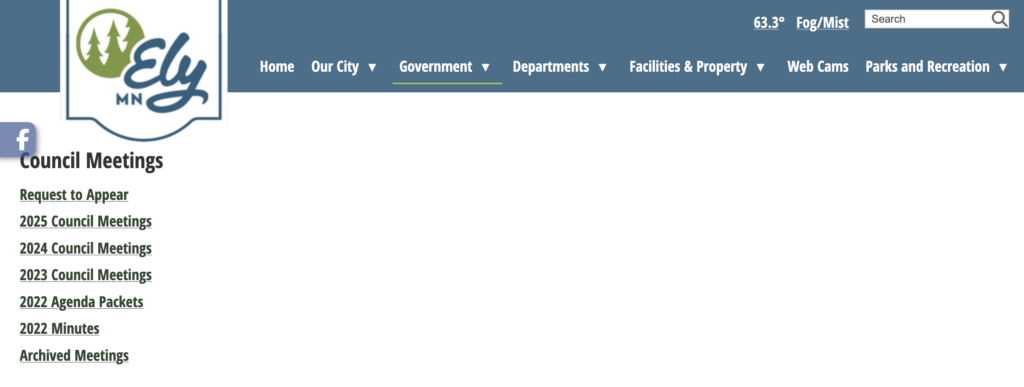
The agenda itself is usually vague. The documents in the Council packet are what’s important: attachments submitted by persons requesting to speak, documents submitted by City Staff for their reports, budgets and expenditures, AND the (draft) minutes of EEDA and other committees, boards, commissions and authorities. Concerned citizens and residents need adequate time to read, reflect, share, discuss, and contact City Hall, elected officials, and community experts if they are concerned or have questions. The Mayor made it very clear that people cannot suddenly voice their opinions and facts during the Request to Speak portion of the agenda. People can do this only at the end of Council meetings AFTER Council voted. People have less than 12 hours to read and respond to tonight’s agenda and Council packet.
Since last Friday, July 3rd, we had been looking for the Council agenda and packet to be posted online for tonight’s scheduled Council meeting on Tuesday, July 7th. The meeting had not been cancelled per the Public Calendar. https://www.ely.mn.us/calendar.
We also noticed that the City website was no longer posting information about upcoming or previous documents about all of the 2026 City Council meetings.
An Elyite read an email sent out and called City Hall. Thank you!
The explanation was 2026 Council documents were placed on the 2025 webpage. Because we do not have access to programming, coding, etc. we cannot prove WHEN 2026 Council documents were removed or misplaced — nor who is/was responsible for changes — nor who is accountable for checking the City website.
One person claims they looked at 2025 Council documents when they noticed 2026 were missing and did not find 2026 documents under 2025. We do not have documentation/proof. Again, the truth lies within the coding changes.
The July 7th City Council agenda and 51-page Council packet are now posted online at https://www.ely.mn.us/council-meetings. There seems to be absolutely no official explanation for the removal and/or displacement of the 2026 Council documents. Hopefully, there will be an official explanation at tonight’s Council meeting AND how this does not violate any Open Meeting Laws.
We ourselves do not have time to review and comment on what’s on the agenda and in the Council packet. Plus, there might be additions and changes presented just before tonight’s meeting that might not be posted online. Check the table inside Council Chambers for documents.
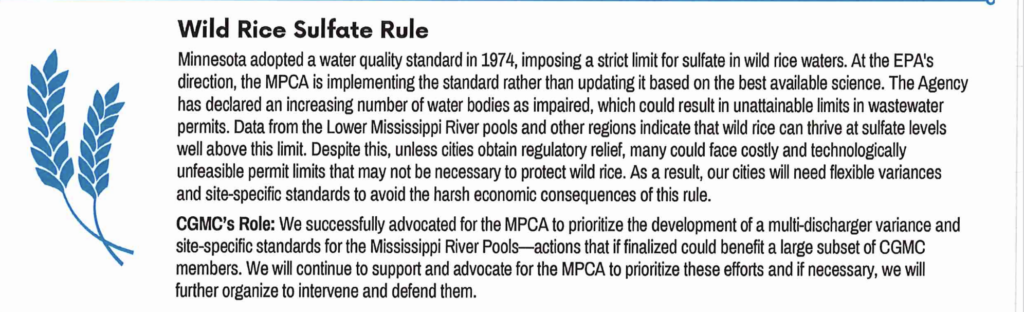
Glance over the documents submitted by the Coalition of Greater Minnesota Cities. Do you agree with what they are doing? Do Council Members, the Mayor and City Administration agree with the Coalition? Here’s one paragraph to spark your interest in reading more
Glance over the documents submitted by the Coalition of Greater Minnesota Cities. Do you agree with what they are doing or reporting? Do Council Members, the Mayor and City Administration agree with the Coalition? Here’s one paragraph to spark your interest in reading more.
Look over the (draft) minutes in tonight’s Council packet
Look at last month’s June 16th Council meeting (3 weeks ago). Look over the (draft) minutes submitted by EEDA and other commissions, committies, boards and authorities. There are so many funding and development resolutions approved by Council. Who on Council, the current Mayor, or Commissioners raised questions about community priorities and how these approvals related to essential community needs?
Our 2 local newspapers do not cover all of these items. You have to read the posted documents. Here are some tidbits to get you to read the (draft) minutes; who asked deep questions about community priorities; and who voted on what.
Remember the luxury hotel that once was our Community Center? The liquor license is addressed but not the parking. Note: the City stepped in to supposedly secure parking for the owner instead of the owner acquiring it themselves at their expense.
Remember the luxury hotel that once was our Community Center? The liquor license is addressed but not the parking. Note: the City stepped in to supposedly secure parking for the owner instead of the owner acquiring it themselves at their expense.
The owner keeps changing its name. We’ve posted many times about funding and too rapid approval by Council. Search our website and start with https://elyminnesota.com/blog/city-council-oct-1-2024/. We’ll post later the link to when Planning & Zoning wanted to turn the Senior Center parking lot into a parking lot for the hotel.
There are some tidbits about the Old Train Depot site.












3 BOAs and P&Z mtg July 15 2026
3 Board of Adjustment Hearings starting at 4:45 pm on Wed, July 15th.
Read further to find out how to get the most background details and documents before BOA meetings.
Community members are planning on speaking.
Planning & Zoning Commission meeting starts at approx. 5:30 pm, Wed., July 15th.
The 5-page packet is available at https://www.ely.mn.us/pzmeetings. Only the June 17th draft minutes are attached, no other documents.
Scroll down to the bottom of this post to see how City Hall and/or City web designers have suddenly changed the placement of Public Notices on the City webpages, making it even more difficult for the public to access information in a timely manner, info concerning them with a deadline for them to comment.
Please read the details about these 3 BOA Hearings. Many community members are concerned about all 3 and are planning to speak or have submitted comments. Please inform yourselves. We are all concerned about the fires around Ely and our friends, family members, relatives and colleagues dealing with (potential) evacuations. Despite ongoing community concerns about local fires and evacuations, BOA will not reschedule tomorrow’s meetings. BOA rulings are final unless owner appeals to Council. Citizens cannot appeal.
Get as much information as you can about the BOA Hearings
You may or may not find links to additional documents when you open links on the Public Notices page. Even though there might be maps, photos, and other documents. in the hands of City Hall. There seems to be no standard procedure for what is posted (available via links on the Public Notices webpage). Hmmm
Always check the BOA documents (agenda and documents) posted on the Planning & Zoning Meetings webpage., sometimes a day or 2 before the BOA Hearing. https://www.ely.mn.us/pzmeetings There is usually more background information here, along with City “Staff Analysis” or “Fact Finding.” We are not saying something nefarious is going on. Just BE AWARE more documents exist and may/will be released.
Here’s what the public is given for these 3 BOA’s via Public Notices and P&Z Meetings webpage:
Business violating home occupation standards. No background info or other documents to look at per Public Notices. P&Z post has 18 pages.
Dog boarding 101 pages in Public Notices link. Undated “Staff Analysis.” P&Z post has 134 pages.
“Rooming House” for recovering persons with substance use disorders. 2 sets of documents = 46 pages in Public Notices. P&Z post has 112 pages.
Prepare for the P & Z meeting — after the 3 BOA’s Hearings
5-page packet is at https://www.ely.mn.us/pzmeetings. Only the June 17th draft minutes are attached, no other documents. Check their website and the table inside Council Chambers for any changes or additions to the original agenda.
Very often, topics and discussions at one meeting are continued at subsequent meetings. For more info about “Special Vehicle Ordinance,” read the draft minutes from their June meeting when Adam Bisbee and daughter Olive spoke. For even more information, look at
Special note about City Website Design and Placement Changes
Once again, City Hall and/or City webpage designers are making it more difficult for people to easily access information. All of a sudden, the Public Notices webpage has been buried. It now longer appears as a separate important entry under the Government or Our City webpages.
If you don’t just automatically click on Our City to see the menu options, you might see Public Notices as a subpage or subsection of the Public Calendar. Who would ever think of Public Notices being posted (= buried) under the Public Calendar? Who was behind this decision? Who directed the City’s webpage designer to make this change? Is the City webpage designer being guided and supervised? Or does the webpage designer just autonomously decide whatever they want , because it just “feels good” or “looks cute”? Who is the web designer? Was there a job description with a job interview? Was Elon Musk listed as a reference?
What’s strange about the new design change:
1. Where does it say “Public Notice” on the calendar?
2. Is this a “Public Calendar” (Our City webpage) or a “Public Meeting Calendar” (Government webpage)?
3. Who thinks concerned citizens are going to click and every item on the calendar to find out if there one’s a Public Notice?
This is another version of Government webpage listing the topics. Public Notices is not listed here. It is not even listed under Public Meetings Calendar (nor in white).
Both versions of Government webpage say “Public Meetings Calendar.” Both versions of Our City say “Public Calendar.”
For a variety of reasons, intentionally orchestrated or not, the City has an extremely poor turnout for their Public Hearings. It’s not that nobody is interested. It’s the City expends the least amount of time, energy and money to inform people about the hearings. Citizen input slows the process and interferes with what the City intends to do.
This summer, the City and/or its webpage designer are making it even harder for concerned citizens to learn about meetings, prepare adequately for them, and submit comments. We wrote about upcoming and past 2026 meetings (dates, agendas and documents) suddenly disappearing from the City webpages. See https://elyminnesota.com/blog/2026-council-mtg-info-delayed/ No official explanation has been posted. We’re wondering what else has happened that nobody has noticed, including whoever is supposed to be “supervising” the webpage designer.