A sample text widget
Etiam pulvinar consectetur dolor sed malesuada. Ut convallis
euismod dolor nec pretium. Nunc ut tristique massa.
Nam sodales mi vitae dolor ullamcorper et vulputate enim accumsan.
Morbi orci magna, tincidunt vitae molestie nec, molestie at mi. Nulla nulla lorem,
suscipit in posuere in, interdum non magna.
|
 I’ve been haunted by Fletcher Freeman’s letter (4/6/13 Ely Echo), in which he says that “sulfide mining is going to happen” because the rich “don’t let rules, regulations and laws get in their way.” Based on his experience with millionaires and billionaires in Texas, Fletcher knows that they can, and will, buy legislators and special favors. The rich have ways to get their way. Therefore, Fletcher argues, the best that environmentalists opposed to copper/nickel mining can hope for is “negotiating a cleanup and/or damage mitigation fund.” I’ve been haunted by Fletcher Freeman’s letter (4/6/13 Ely Echo), in which he says that “sulfide mining is going to happen” because the rich “don’t let rules, regulations and laws get in their way.” Based on his experience with millionaires and billionaires in Texas, Fletcher knows that they can, and will, buy legislators and special favors. The rich have ways to get their way. Therefore, Fletcher argues, the best that environmentalists opposed to copper/nickel mining can hope for is “negotiating a cleanup and/or damage mitigation fund.”
I suppose that Fletcher is right about how the CEOs who control Glencore, Antofagasta, and the other big international mining corporations will proceed with their plans to get richer. But I cannot accept Fletcher’s depressing conclusion that giant sulfide mines here at the edge of the BWCAW, with resultant environmental damage, are inevitable. I will continue to add my voice to many others who think that the gains of this kind of mining here are not worth the risks. Why? Because (1) I am an American who believes in democracy, (2) I am a grandfather, and (3) stuff happens:
- Our country is special because it is founded on the belief that government exists by, for, and of the people — all the people, not just the rich. I believe that my vote should count exactly the same as the vote of a rich person. I fear that our democracy is in grave danger if we allow special interests, with their legions of lobbyists and undisclosed funding of political candidates, to call the shots.
- I want to congratulate Fletcher on recently becoming a grandfather! Grandparenthood changes us. I know I want my grandkids to be able to enjoy canoe trips on pristine lakes, to be able to catch and eat a fish, to see the starry host in the dark northern sky. I do not want a grandchild to confront me, years from now, and ask why I didn’t do more to protect the BWCAW or put the brakes on global warming.
- The mining corporations can make all kinds of promises, but we all know that stuff happens: floods, explosions, human error, shortcuts to save money. In our water-rich environment, we know that water will eventually get to wherever we humans try to prevent it — and the result in this case will be damaging acid runoff.
With a new Climate Change Study Group here in Ely, I’ve been reading Storms of My Grandchildren, by climate scientist James Hansen. Alongside good science and dire forecasts, the author tells many stories of how special interests have connived to discredit and silence scientists, manipulate politicians, and postpone any meaningful legislation to slow down human-caused climate change. In other words, the gas and coal CEOs are determined to keep enriching themselves and their stockholders, democracy and grandchildren be damned! Which is just what Fletcher would expect, but just what we the people cannot accept. There’s too much at stake now to resign ourselves to the way the rich (in Fletcher’s words) play their games.
Elton Brown, Morse Township
 Photo Credit ShutterStock.com March 28, 2013 | This article was published in partnership with GlobalPossibilitie.org by AlterNet / By Joe Uehlein, Gus Speth www.alternet.org
SUMMARY:
We recognize the need to strengthen the solidarity between our movements to be successful.
It is easy to identify important national goals where our alliance must be strong and our collaboration active:
- supporting actions at the national, state, and local levels to reduce America’s climate-changing greenhouse gas emissions;
- creating healthy and safe green jobs in such areas as clean energy, transportation, and modern infrastructure;
- revitalizing America’s cities and towns through a focus on environmental quality, locally committed enterprise, community solidarity, and strong democracy;
- reforming America’s politics to reverse the growing ascendancy of money power over people power; and
- providing ample opportunities for decent work, living wages, and continuing self-improvement.
Harriet Barlow, Director Blue Mountain Center
Ron Blackwell, Former Chief Economist AFL-CIO
Jeremy Brecher, Co-Founder Labor Network for Sustainability (LNS)
John Cavanagh, Director Institute for Policy Studies (IPS)
Mijin Cha, Senior Policy Analyst Demos
Katie Corrigan, Policy Director, Kalmanovitz Initiative for Labor and the Working Poor, Georgetown University
Bob Engelman, President WorldWatch Institute
Sarita Gupta, Executive Director Jobs with Justice
Bruce Hamilton, International Vice President Amalgamated Transit Union (ATU)
Mark Levinson, Chief Economist Service Employees International Union (SEIU)
Yvette Pena Lopes, Deputy Director BlueGreen Alliance (BGA)
Bob Massie, President New Economics Institute/New Economy Coalition
Joseph McCartin, Professor, and Executive Director, Kalmanovitz Initiative for Labor and the Working Poor, Georgetown University
Bill McKibben, President and Co-Founder, and May Boeve, Executive Director and Co-Founder, 350.org
Alden Meyer, Director of Strategy and Policy Union of Concerned Scientists
Lawrence Mishel, President Economic Policy Institute
Carla Lipsig Mumme, Professor of Work and Labor Studies; York University Director, Work In A Warming World
Ken Peres, Chief Economist Communications Workers of America (CWA)
Jeremy Richardson, Kendall Science Fellow in Clean Energy Innovation, Union of Concerned Scientists
Scott Slesinger, Legislative Director Natural Resources Defense Council (NRDC)
Rosemary Sokas, MD, MOH; Professor and Chair Department of Human Science
Georgetown University School of Nursing and Health Studies
Gus Speth, Author, Professor Vermont Law School
Margrete Strand Rangnes, Vice President Public Citizen
Ananda Lee Tan, US and Canada Regional Coordinator Global Alliance for Incinerator Alternatives (GAIA)
Betsy Taylor, President Breakthrough Strategies & Solutions
Joe Uehlein, Executive Director Labor Network for Sustainability (LNS)
Mike Williams, Senior Policy and Legislative Advocate BlueGreen Alliance (BGA)
Jeremy Brecher, Co-Founder Labor Network for Sustainability (LNS)
John Cavanagh, Director Institute for Policy Studies (IPS)
Mijin Cha, Senior Policy Analyst Demos
Katie Corrigan, Policy Director, Kalmanovitz Initiative for Labor and the Working Poor, Georgetown University
Bob Engelman, President WorldWatch Institute
Sarita Gupta, Executive Director Jobs with Justice
Bruce Hamilton, International Vice President Amalgamated Transit Union (ATU)
Mark Levinson, Chief Economist Service Employees International Union (SEIU)
Yvette Pena Lopes, Deputy Director BlueGreen Alliance (BGA)
Bob Massie, President New Economics Institute/New Economy Coalition
Joseph McCartin, Professor, and Executive Director, Kalmanovitz Initiative for Labor and the Working Poor, Georgetown University
Bill McKibben, President and Co-Founder, and May Boeve, Executive Director and Co-Founder, 350.org
Alden Meyer, Director of Strategy and Policy Union of Concerned Scientists
Organizations listed for identifications purposes only
Complete Article here:
March 28, 2013
This article was published in partnership with GlobalPossibilities.org.
During our many decades of work in the labor and environmental movements, there have been many battles that led to tensions between our communities. The Keystone Pipeline is only the most recent example. To help overcome these challenges, we recently convened two dozen leaders of labor, environmental, and other organizations for a frank conversation about the difficult times faced by ordinary workers and the dire environmental prospects we all face. We were motivated by a deep conviction that our communities could unite behind a common vision of a new economy that is good for working families and for the planet. We know that a top priority of most people is decent, dignified jobs that advance a truly sustainable economy.
And, at the end of our conversation, we were heartened by the unity we found in this diverse group of leaders behind a common vision. And we hoped that by developing the following joint statement, we could help build broader consensus around this vision and steps towards achieving it.
Labor-Environment Solidarity
for a More Just and Sustainable Economy
This statement grows out of a discussion at Georgetown University on February 15, 2013 among leaders and organizers from the labor, environmental, and democracy movements sponsored by the Labor Network for Sustainability (LNS) and Georgetown’s Kalmanovitz Initiative for Labor and the Working Poor (KI).
For decades, there have been initiatives by labor and environmental leaders at local, state, and national levels to forge closer ties between these two communities, from Environmentalists for Full Employment in the 1970s to the Blue-Green Alliance and the Labor Network for Sustainability today.
Despite these efforts, there have been times of tension and conflict. The debate over the Keystone XL pipeline today is only the most recent of such moments. Many in the environmental movement have made stopping the pipeline a top priority for 2013, and many but not all in organized labor are backing the pipeline as a source of good jobs. There have been a number of instances in recent years where leaders in each of these communities have failed to acknowledge the concerns of the other.
Nonetheless, many leaders and organizers within these movements recognize that they share many values and are prepared to help define a common vision and lead a struggle for a more just and sustainable economy. In the short-term, we feel that there are many things that each community can do to advance mutual interests and concerns. Longer term, we feel that articulating a common vision for a new economy is necessary to allow these movements to serve their individual interests, but also to contribute to building a better society.
In a recent dialogue among the signers of this statement, we were struck by a common commitment to build on shared values to strengthen our solidarity by developing a shared vision, identifying obstacles and building a common agenda to move forward together.
We agree on the urgent need to build a more just and sustainable economy. We recognize the need to strengthen the solidarity between our movements to be successful. And, we are confident that an honest dialogue among leaders and activists in our movements is key to developing the shared vision necessary to strengthen our solidarity.
We recognize that the American economy is neither sustainable, nor just. We are on a climate change path that unless radically altered will lead to global warming of seven degrees Fahrenheit or greater. We are also in the most serious employment crisis since the Great Depression, wages have stagnated for over three decades and economic inequality is worse than any time since the 1920s.
We recognize that our shared goals cannot be realized without challenging the undue influence that corporations exercise over our economic system and our political process.
We also recognize the many factors that make it difficult for our movements to act in concert. Some of these affect cooperation in the short term; others are deeper and longer-term differences of perspective. Too often the cultures and organizations of the labor movement are indifferent to the challenges of sustainability. Too often, the environmental movement is inattentive to the injustice of the American economy.
Finally, despite the challenge to unity represented by the KXL pipeline, we recognize there is a larger common purpose to be served through dialogue among leaders and organizers of these movements to define and fight for an economy that works for all, but that also respects the limits of the environment we share.
Among the many labor and environmental organizations engaged in serving these shared values and realizing a common vision, the Labor Network for Sustainability is hosting a dialogue among leaders and organizers to help define an economy that realizes their shared values and to advocate for the policies necessary to serve them.
It is easy to identify important national goals where our alliance must be strong and our collaboration active:
- supporting actions at the national, state, and local levels to reduce America’s climate-changing greenhouse gas emissions;
- creating healthy and safe green jobs in such areas as clean energy, transportation, and modern infrastructure;
- revitalizing America’s cities and towns through a focus on environmental quality, locally committed enterprise, community solidarity, and strong democracy;
- reforming America’s politics to reverse the growing ascendancy of money power over people power; and
- providing ample opportunities for decent work, living wages, and continuing self-improvement.
Looking ahead, we will begin in earnest a dialogue on how to realize an America where the true and actual priorities of economic and political life are sustaining people, place, and planet; where social justice and solidarity are prized; and where peace, communities, democracy, and nature all flourish. We believe it is possible to build a new economy and a new politics. Many of the needed answers are already at hand, and others can be found. Our nation can realize a future that is equitable and ecologically balanced, but to do so we must build a movement supported by a broad base of citizens committed to transformative change. We will work together towards these ends.
Harriet Barlow, Director Blue Mountain Center
Ron Blackwell, Former Chief Economist AFL-CIO
Jeremy Brecher, Co-Founder Labor Network for Sustainability (LNS)
John Cavanagh, Director Institute for Policy Studies (IPS)
Mijin Cha, Senior Policy Analyst Demos
Katie Corrigan, Policy Director, Kalmanovitz Initiative for Labor and the Working Poor, Georgetown University
Bob Engelman, President WorldWatch Institute
Sarita Gupta, Executive Director Jobs with Justice
Bruce Hamilton, International Vice President Amalgamated Transit Union (ATU)
Mark Levinson, Chief Economist Service Employees International Union (SEIU)
Yvette Pena Lopes, Deputy Director BlueGreen Alliance (BGA)
Bob Massie, President New Economics Institute/New Economy Coalition
Joseph McCartin, Professor, and Executive Director, Kalmanovitz Initiative for Labor and the Working Poor, Georgetown University
Bill McKibben, President and Co-Founder, and May Boeve, Executive Director and Co-Founder, 350.org
Alden Meyer, Director of Strategy and Policy Union of Concerned Scientists
Lawrence Mishel, President Economic Policy Institute
Carla Lipsig Mumme, Professor of Work and Labor Studies; York University Director, Work In A Warming World
Ken Peres, Chief Economist Communications Workers of America (CWA)
Jeremy Richardson, Kendall Science Fellow in Clean Energy Innovation, Union of Concerned Scientists
Scott Slesinger, Legislative Director Natural Resources Defense Council (NRDC)
Rosemary Sokas, MD, MOH; Professor and Chair Department of Human Science
Georgetown University School of Nursing and Health Studies
Gus Speth, Author, Professor Vermont Law School
Margrete Strand Rangnes, Vice President Public Citizen
Ananda Lee Tan, US and Canada Regional Coordinator Global Alliance for Incinerator Alternatives (GAIA)
Betsy Taylor, President Breakthrough Strategies & Solutions
Joe Uehlein, Executive Director Labor Network for Sustainability (LNS)
Mike Williams, Senior Policy and Legislative Advocate BlueGreen Alliance (BGA)
Jeremy Brecher, Co-Founder Labor Network for Sustainability (LNS)
John Cavanagh, Director Institute for Policy Studies (IPS)
Mijin Cha, Senior Policy Analyst Demos
Katie Corrigan, Policy Director, Kalmanovitz Initiative for Labor and the Working Poor, Georgetown University
Bob Engelman, President WorldWatch Institute
Sarita Gupta, Executive Director Jobs with Justice
Bruce Hamilton, International Vice President Amalgamated Transit Union (ATU)
Mark Levinson, Chief Economist Service Employees International Union (SEIU)
Yvette Pena Lopes, Deputy Director BlueGreen Alliance (BGA)
Bob Massie, President New Economics Institute/New Economy Coalition
Joseph McCartin, Professor, and Executive Director, Kalmanovitz Initiative for Labor and the Working Poor, Georgetown University
Bill McKibben, President and Co-Founder, and May Boeve, Executive Director and Co-Founder, 350.org
Alden Meyer, Director of Strategy and Policy Union of Concerned Scientists
Organizations listed for identifications purposes only
February 25, 2013
 Editor The Ely Echo Editor The Ely Echo Dear Editor: Dear Editor:
Old attitudes die hard, as Joe Folio’s letter in the February 23 Echo demonstrates. Ely is rightfully proud of its iron mining history. However, the current effort to romanticize that history ignores much of its dark underside. Ironically, Mr. Folio’s letter underscores one of those darker aspects. Mr. Folio’s paean to mining and the way he says Ely used to be contains these important facts: “the mines closed and 400 people lost their jobs.” So goes the boom and bust of mining. Few things are more foolish for a community than hitching its economic wagon to the resource extraction star. Our neighbor Virginia is surrounded by mining and related activity, and Virginia has been losing population for decades; it fell from 14,034 in 1960 to 8,712 in 2010. Every census after 1960 shows a decline. Economic studies consistently prove that resource-extraction communities are poorer and less well-educated than communities that look elsewhere for economic well-being.
Further, the metallic sulfide ore mining being proposed for the Spruce Road/Kawishiwi River/Birch Lake region has little in common with the labor-intensive iron mining that occurred in and around Ely. The copper and other minerals encased in the sulfide ores are economically recoverable only because mining technology has developed to allow massive increases in output with fewer employees. If we as citizens in fact allow these mines to operate, employment will be a fraction of the employment in the iron mines, and most jobs will not go to local people. More important, as anyone who has been paying attention knows by now, metallic sulfide ore mining is a poisonous and destructive enterprise. The U.S. Environmental Protection Agency has reported that hardrock mining-which is simply another name for the metallic sulfide ore mining that the multinationals propose to inflict upon us-accounts for more than 40% of the Superfund sites in the United States.
Ely cannot have it both ways. As painful as it is for many to admit, the Boundary Waters Canoe Area Wilderness saved Ely. Mr. Folio rues the loss of population and businesses after the mines closed, but the attraction of one of the world’s great wilderness areas kept people coming here. It enabled many existing local businesses to stay afloat and inspired the creation of new businesses. Some people left Ely for careers elsewhere, were successful, and returned to invest in the community. Others who were not originally from Ely came here, saw an interesting and active community in the midst of a beautiful landscape, and laid down their cash. Those kinds of investments will come to a screeching halt when Basswood and many other lakes are polluted by the flow from the Kawishiwi, the groundwater is no longer drinkable, and gaining access to key entry points to the BWCAW requires traversing an industrial mining zone. Property values have already been hit hard in the exploration areas.
Mr. Folio repeats the common charge that people who are opposed to metallic sulfide mining here are “selfish.” Who is more selfish? People who invested significant portions of their lives and savings in businesses and property because of a pleasant community, relatively clean water and air, and a healthy forest, and who want to preserve those things in the face of a mining juggernaut? Or mining companies who will run roughshod over public and private lands, and over everybody’s water and air, to enrich themselves without regard for the businesses, homes, and lives that others have built?
Reid Carron
Town of Morse
Outdoor recreation is essential to the American economy, 11.6 billion in consumer spending in Minnesota alone. Every year, Americans spend $646 billion on outdoor recreation — on gear, vehicles, trips, travel-related expenses and more. This creates jobs, supports communities, generates tax revenue and helps drive the economy. Throughout America, people recognize that outdoor recreation and open spaces attract and sustain families and businesses, create healthy communities and foster a high quality of life.
Click to see the report on Minnesota.
To see information about other states. click on the state to see that states information.
 Opponents of copper mining in Minnesota might be winning over more state residents, according to a new poll that shows more people oppose the new kind of mining here than support it. Opponents of copper mining in Minnesota might be winning over more state residents, according to a new poll that shows more people oppose the new kind of mining here than support it.
The poll, paid for by the Minnesota Environmental Partnership and released Wednesday, found that 48 percent of state residents polled opposed copper mining while 39 percent favor the projects.
It’s the first time in five years the poll has been taken that more people opposed than supported copper mining. The coalition of 75 environmental groups conducts the survey annually to gauge public opinion on several key conservation issues.
The results show support for mining slipping from a high of 66 percent in 2009 to 62 percent in 2010, 52 percent in 2012 and 39 percent this year.
Statewide, opposition increased from 19 percent in 2009 to 48 percent this year.
The telephone poll was conducted Jan. 6-8 by the team of California-based Fairbank, Maslin, Maullin, Metz and Associates along with Alexandria, Va.-based Public Opinion Strategies. Of those people polled, 251 respondents answered the mining question. The margin of sampling error is 6.2 percent.
The question, which has been asked since 2008, was: “As you may know, new mines are being proposed near the Boundary Waters and Lake Superior. These are different from the traditional Minnesota iron ore mines. These new sulfide mining operations would be used to extract copper, nickel, and other precious metals from underground rock formations containing sulfur.
Based on this description, would you favor or oppose these new mines?”
It’s not clear what impact, if any, the poll would have on mining proposals as they advance through prospecting and regulatory stages. The issue is not expected to seriously surface during the current legislative session.
Mining supporters said they’ve seen just the opposite — growing support for the expansion into copper, nickel and other precious metals that have never been mined in the state.
“I’m not going to speak to their poll results. But everything we’ve seen as an industry, both formal and informal, shows continued strong to overwhelming support for mineral development in Minnesota,” Frank Ongaro, president of Mining Minnesota, a coalition of copper mining companies, told the News Tribune. “That public support is reflected at the local level, the state level and in elected officials at the federal level.”
But copper mining skeptics say a gradual increase in statewide news coverage and public discussion of copper mining has increased awareness of potential pollution problems.
“I think the change over the last few year shows that, the more people hear about it, the more information they get, the more questions they have,” said Steve Morse, executive director of Minnesota Environmental Partnership. “When we first started asking this question, very few people knew about the issue. Support grew a little at first, and then it’s been dropping as the state has more discussion on the potential dangers.”
Morse noted that other poll questions show strong support for strict regulations on copper mining, even among supporters. The group has not yet release results on other issues covered in the poll.
Several companies are considering mining operations in Northeastern Minnesota to extract copper, nickel, gold, platinum, palladium and other valuable metals from the so-called Duluth complex of rock. Geologists say it’s among the largest untapped deposits of those minerals in the world.
Supporters say mining the minerals will be an economic boon for the region and the entire state, creating thousands of jobs and pumping millions of dollars into the economy and state tax coffers.
PolyMet, which plans a $600 million open pit mine and processing center near Hoyt Lakes employing 350 people for 20 years or more, is the closest to reality, with a combined state/federal environmental review set to conclude this year and permits possibly issued as early as next year.
Opponents say the long-term potential for acidic runoff from copper-bearing rock, and other water pollution problems, isn’t worth the relatively short-term benefit of jobs. They say the boom-and-bust cyclical nature of the mining industry is not sustainable for the region.
The Minnesota Environmental Partnership is a coalition of more than 75 environmental and conservation organizations in the state that focus on water, energy and land conservation issues.
The poll results come as the Lake Superior Binational Forum has a public meeting set for Friday afternoon at Mesabi Range Community College in Virginia to discuss the impact of copper mining in the Lake Superior region.
By: John Myers, Duluth News Tribune
 In response: Potential risk of sulfide mining too great for local environment. The writers of the Feb. 26 Local View column, “Mining prospects spread optimism in the Northland,” wrote enthusiastically about the potential economic wealth associated with making use of the copper, nickel and other metals that are plentiful in our region. In response: Potential risk of sulfide mining too great for local environment. The writers of the Feb. 26 Local View column, “Mining prospects spread optimism in the Northland,” wrote enthusiastically about the potential economic wealth associated with making use of the copper, nickel and other metals that are plentiful in our region.
By: Susan Nordin, for the News Tribune
The writers of the Feb. 26 Local View column, “Mining prospects spread optimism in the Northland,” wrote enthusiastically about the potential economic wealth associated with making use of the copper, nickel and other metals that are plentiful in our region.
However, they failed to mention the negative impacts the mining of those metals could have in the form of pollution, environmental harm, human health issues and the potential of cleanup costs that would have to be paid for by taxpayers when the mining is done.
On the same page, the News Tribune’s editorial (Our View: “Unlikely coalition shows mining urgency”) included a quote suggesting environmental messes connected to metals mining happened decades ago, before the Clean Water Act. That would be simply incorrect. Mine pollution requiring expensive cleanup has occurred since the Clean Water Act in numerous states, including Arizona, Utah, Nevada and New Mexico.
As a physician, I am concerned about the potential health effects of sulfide mining. I am alarmed that the proposed mines would be so close to the Boundary Waters Canoe Area Wilderness and the tributary waterways that flow into the St. Louis River and, ultimately, into Lake Superior.
Will the mining companies spend a lot of money trying to offset potential pollution around the mines? Of course. But unfortunately, accurately predicting the ultimate deleterious effects of acid-mine drainage is very complex. Despite the best science and resources spent to avoid it, acid-mine drainage remains a main source of environmental damage related to sulfide mining. Unlike iron mining, sulfide mining for copper produces sulfuric acid and releases metals that can enter waterways near mines. This can seriously affect fish and marine habitats and water quality, and this can have unknown effects on human health.
Arsenic, manganese and thallium are present in some acid-mine drainage. High levels of these metals in drinking water definitely affect human health and can cause illness.
Frighteningly, mining companies struggle to cite a single example of a sulfide mine that has not produced polluted drainage. Are we willing to risk our own main source of fresh water in exchange for money?
There is a reason the BWCAW is protected. Not only does it provide habitat for animals and fish, it offers a place of refuge and rejuvenation for human beings, which is important for optimal health. The wilderness area is a vital part of what draws people to this region and is a large source of revenue in tourism. Sulfide mining risks polluting and spoiling our wilderness area.
There are examples in Montana and Colorado of unintended acid-mine drainage leaving miles of river devoid of fish and aquatic life. Can something like that be mitigated? Do we want to risk that happening in Minnesota?
The cost of mitigation also is a concern. It is tempting to think about the potential economic gains that come with mining, but mining companies elsewhere have declared bankruptcy and left taxpayers responsible for cleanup.
I recognize the need for copper and other metals in society. I am not “anti-mining.” However, the potential risk of sulfide mining to our local environment and source of fresh water bears serious thought. The price of sulfide mining is too high. There are too many risks, and there’s a lack of evidence that sulfide mining will not cause irreparable environmental harm and risk to human health.
Susan Nordin of Duluth is a family physician for the University of Minnesota School of Medicine concerned about the potential for health impacts related to precious-metals mining.
 Benefits ONLY! We forgot Costs. The latest report from the UMD Labovitz School of Business and Economics (as reported on by the News Tribune in the Feb. 7 story, “UMD report underscores value of iron ore mining, potential for copper”), is business as usual in the world of mining in Minnesota.
Once again we get a promotional brochure for the mining industry masquerading as an economic report.
To make judgments about proposed industrial developments, the civilized world usually agrees that a cost-benefit analysis is required. But all we get from the University of Minnesota Duluth is a list of benefits. There was no apparent discussion of costs, of elevated sulfates in Lake Vermilion or of heavy metals leaching from the Dunka pit. I noticed no hint of the dead zone for wild rice in the St. Louis River, no analysis of the blighted communities along the length of the Mesabi Range and no acknowledgement of the poverty rate in Virginia, the heart of the Mesabi Range.
“Regulatory capture” refers to the industry domination of agencies meant to regulate them. “Deep capture” occurs when the industry dominates the media, academia and popular culture. It seems to me the state of Minnesota has been captured by the mining industry.
The editorial pages of the Duluth News Tribune and the publications of the Labovitz School of Business and Economics should be
 Who pays-dictate the results! adequate proof of Minnesota’s subjugation to mining interests.
Robert Tammen
Soudan
Published February 25, 2013, 12:00 AM
Reader’s view: Business as usual for Minnesota mining
The latest report from the UMD Labovitz School of Business and Economics (as reported on by the News Tribune in the Feb. 7 story, “UMD report underscores value of iron ore mining, potential for copper”), is business as usual in the world of mining in Minnesota.
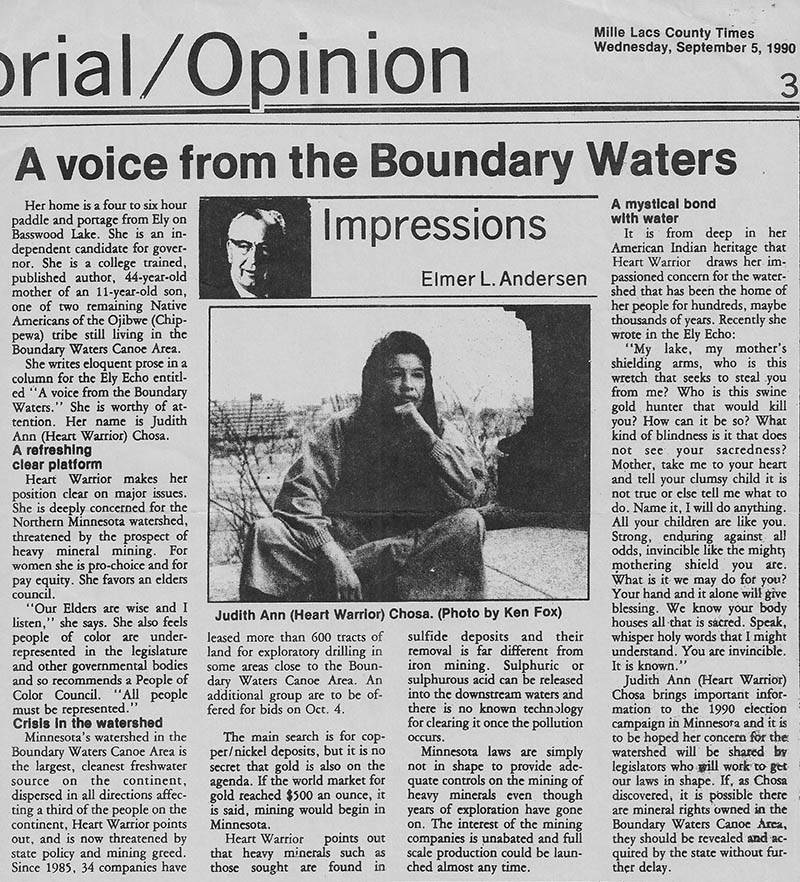
The greatest freshwater eco-system in the U.S. is STILL threatened by state policy and mining greed. Heart Warrior was sounding the alarm in 1990.
 *DNR water officials say it’s time for local communities to start making decisions on water, rather than the state, because the current rates of use are not sustainable.* *DNR water officials say it’s time for local communities to start making decisions on water, rather than the state, because the current rates of use are not sustainable.*
*Nature can’t keep up with demand, prompting disputes in some cities.* (Can you say Hibbing?)
It didn’t take Daniel Damm long to figure out why the water from his faucets suddenly turned black. His well was running dry because the turkey farm up the road near Willmar had sucked down the local aquifer.
In Hibbing, where one of three city wells has dried up, local officials have quietly asked the state to help resolve a water dispute with a taconite company that is one of the town’s biggest employers.
And along the shores of White Bear Lake, homeowners found themselves mowing beyond the end of their docks last summer because one of the Twin Cities’ premier lakes is shrinking. They filed suit, charging the state government with failing to manage its most precious resource — water.
Minnesotans have always prided themselves on their more than 10,000 lakes, great rivers and the deep underground reservoirs that supply three-fourths of the state’s residents with naturally clean drinking water.
But many regions in the state have reached the point where people are using water — and then sending it downstream — faster than the rain and snow can replenish it.
Last year, Minnesotans used a record amount of water, fueling a rising number of conflicts from the Iron Range to Pipestone.
Now state regulators, who have never said no to a water permit, for the first time are planning to experiment with more stringent rules that will require some local communities to allocate scarce water.
“It’s scary,” said Dennis Healy, who runs the Pipestone Rural Water System in southwest Minnesota. “The time is coming that there is going to have to be some rationing.”
In the short term, that means farmers and businesses may have to share water with competitors, or even leave the state. Eventually, homeowners may face higher water bills and routine watering bans.The prolonged drought that scorched Minnesota last summer is not to blame, but it provides a glimpse into how climate change, with its weather extremes, could make matters even worse. From now on droughts may be more severe. And then when it rains, it often rains so hard that much of the water runs off the land before it can soak into the ground.
In Minnesota, how the rain falls and the snow melts is crucial because virtually all the state’s water comes from the sky. Over the centuries, water accumulated below the surface, slowly seeping into the ground and the aquifers that store many billions of gallons between grains of sand and fissures in the rock. Today that groundwater and the aquifers supply most of the homes, ethanol plants, millions of irrigated acres, swimming pools and golf courses across the state.
 Rising demand (and not even mentioned in this article is the tremendous demand for water by Copper Nickel Sulfide mining and exploraion and its effects on our lakes, rivers, and wetlands, yes and wells in Northeastern Minnesota.) Rising demand (and not even mentioned in this article is the tremendous demand for water by Copper Nickel Sulfide mining and exploraion and its effects on our lakes, rivers, and wetlands, yes and wells in Northeastern Minnesota.)
It all works fine as long as water is not used faster than the rain and snow can replace it. But now rising demand — from farm irrigation, a growing ethanol industry, a rising population — is pumping more water out of the ground than ever before.
And once it leaves the aquifer, it’s gone — routed through storm sewers or water treatment plants and into streams, rivers, and sooner or later, out of the state altogether.“We are not running out of water,” said Jim Stark, head of the Minnesota office of the U.S. Geological Survey. “But we are depleting it.”
The most visible example is White Bear Lake.Since 1980, nearby communities have more than doubled the volume of water they pump from the Prairie du Chien aquifer they share with the lake, primarily because of higher residential demand. Now, the lake drops even during wet periods.
Once neighbors use that water — for showers, cooking, watering lawns — it becomes wastewater and is sent to the Pig’s Eye treatment plant near St. Paul, where it is cleaned and released into the Mississippi River — short-circuiting the natural system that keeps water in the lake.The U.S. Geological Survey found recently that it would take annual rainfall that is 4 inches above normal just to keep White Bear Lake where it is now.
“We move it downstream,” said Stark. “We don’t recycle it.”
Last year the White Bear Lake Restoration Association filed suit against the DNR, alleging that it violated environmental standards by allowing local communities to take more water than is sustainable for the lake and aquifer. It asked the court to establish protected water levels for both.
DNR officials declined to comment on the pending complaint.
Soon, the problem could spread beyond White Bear Lake. If the Twin Cities metro area grows by half a million people over the next two decades, at current rates of water use, whole sections of the Twin Cities’ aquifers will drop by half, even with normal rainfall, hydrologists say. At that point, state regulators would shut down the pumps to protect what’s left. Even if water use drops by 30 percent over the next decade, there would still be problems in some parts of the metro area, said Ali Elhassan, water supply manager for the Metropolitan Council.
“People plan for the future,” he said. “Well, the future is now.”
The future arrived some time ago in the perennially dry southwest corner of Minnesota, where the geology is not well designed for holding water underground. Healy, of the Pipestone Rural Water System, has had to tell badly needed businesses to find somewhere else to set up shop because the rural water system couldn’t give them enough water — including a large dairy operation that recently took 15 jobs to South Dakota. “In the last year or so we’ve had a lot more requests from people whose wells are failing,” he said. “People are hauling water.”
The demands of agriculture are especially worrisome, he said. Pattern tiling, which drains precipitation off agricultural fields and into ditches, is on the rise, he said.“While I understand the need and benefit, the idea of discharging that water into the nearest stream and rushing it to the Gulf of Mexico as fast as we can does not makes much sense to me,” he said.
High-capacity irrigation wells are also sprouting all over central and western Minnesota. In 2010, only 2 to 3 percent of the state’s cropland was irrigated, but that alone used 29 percent of water pumped out of Minnesota’s ground that year. But in 2012, the state received nearly 200 irrigation permit requests, with another 200 expected this year — two to three times the norm, DNR officials said.
Alan Peterson, head of the Minnesota Irrigators Association and a farmer near Clear Lake, said irrigation is a better form of crop insurance than crop insurance. Lately, the number of irrigated acres in Minnesota has risen steadily with the price of food and commodities. Because when prices are at record highs, the hundreds of thousands it costs for an irrigation system pays off.
“I can double my yield with irrigation,” Peterson said.
Increasingly, however, agricultural water use is driving up disputes. In 2007, when Dan Damm complained to the DNR about the neighboring turkey farm, his was one of just a handful of complaints filed with the state.
“We turned on the water and couldn’t figure out why it was black,” he said. But as a heavy-equipment operator, he knew a lot about the local hydrology, and he figured that the turkey farm had dropped the top of the aquifer below the bottom of his well. The pump was sending up black gunk from the bottom. Once verified, the farm operation paid to replace it, a requirement of state law.
“People have to realize, it’s humans before turkeys,” Damm said.
Last year, the number of well interference complaints spiked at 12 — most of them related to irrigation — compared to a previous yearly average of two. DNR officials say that greatly underrepresents the problem because people often resolve disputes themselves, don’t file a complaint for fear of creating conflicts, or don’t know that they can. The state is also being asked to resolve much bigger problems.
This year, the city of Hibbing finally asked the DNR to weigh in on its ongoing dispute with Hibbing Taconite. For years, the company has been draining the water that collects in one of its massive pits in order to get to the ore that’s below — and then sending the water into a nearby river and eventually Lake Superior. But a side effect is to lower the area’s entire water table; now the level of the aquifer is low enough that one of the city’s primary wells has dried up. The other two are running at capacity, said Gary Myers, general manager of the Hibbing Public Utilities Commission.
He said the city has found a new water source in a different aquifer, but it’s 2½ miles away from town, adding considerably to the $1.2 million cost. Now the question is who should pay.
“That’s an awful lot for us,” Healy said. “But it’s hard to put pressure on them. ”
Officials at Hibbing Taconite declined to comment but said in a statement that negotiations are underway.
Train wreck?
DNR water officials say it’s time for local communities to start making decisions on water, rather than the state, because the current rates of use are not sustainable.
“If you fail to make a choice, then at some point the aquifer will do that for you,” said Jason Moeckel, a water manager for the DNR.
This year the DNR will ask one or two water-strapped communities to bring in their biggest water users — cities, farmers, ethanol plants and others — to negotiate conflicts among themselves. It’s never been done in Minnesota, and though many may like the idea of “local control,” the reality may be much more contentious, officials say.
“Everyone likes [it] until they have to be a bad guy to their neighbor,” said Jim Sehl, a DNR water manager. “That’s going to be the toughest selling point — getting people to accept responsibility for making those tough decisions.”
Such choices may come as a shock to to Minnesotans’ assumptions about water, said Deborah Swackhamer, co-director of the Water Resources Center at the University of Minnesota.Elsewhere in the country per-capita water use is declining, but not in the Land of 10,000 Lakes. That, she said, could require hard adjustments. Higher prices for water could result, or more water recycling, or the controversial idea of allowing cities to re-inject treated water back into aquifers.
And the state may have to start saying no.
“Because they can’t keep giving out permits and waiting for the train to crash,” she said.
There are many serious and legitimate reasons why environmentalists, resort owners, and local residents are worried about the prospect of multiple copper/nickel mines here. I can’t understand why our elected representatives for the most part just give lip service to our concerns while working to expedite a hasty permitting process.
But, EVEN IF there were a foolproof guarantee of no toxic acid leakage… and EVEN IF the mining corporations were to promise that at least half of their hires would be folks with local roots… and EVEN IF the extracted precious metals were not exported to foreign buyers but were guaranteed to be kept locally and in the US, for value-added new industries and jobs… and EVEN IF the mining corporations were truly committed to correcting infractions rather than simply paying fines as part of the cost of doing business their way…
EVEN THEN many of us fear the consequences of letting the genie out of the bottle! Why? Because once the precedent is set, there will be constant pressure to expand, to sell off more mineral rights, to permit new mining operations. Because there are no guarantees against human error (think Exxon Valdez) or the consequences of ever-increasing natural disasters (as in the devastating flooding in Duluth last year). Because the huge electric power needed to operate these mines may require new coal-burning plants that will threaten our air quality. Because many thousands of acres would be lost for wildlife habitat, berry picking, hiking, hunting, birdwatching. Because the noise, the trucks, the lights at night, the heavy industry of multiple mining operations just southeast of Ely would change the character of this place.
This is the edge of the BWCAW! We are stewards of a national treasure, a hugely popular destination, a rare place where lives are changed. Ely is on a roll (compared to other small towns!) precisely because of the creation of the BWCAW: the pristine lakes and fresh air, the quiet and beauty, the rich variety of outdoor activities in all seasons. Our community is bustling with festivals, concerts, special events, and tourists. The Ely Elementary School is experiencing a growth in enrollment. These are some of the reasons more and more of us, young and old, are choosing to settle here, to spend locally, to support our community and school. Our envious friends from noisy, congested places come to visit us; we take them on memorable adventures, show them the stars; they take us out to supper, purchase lures and winter clothing and local art — and buy gas for the long drive back to their cities…
Non-ferrous mining presents a very real threat to the way of life many of us love. Just because precious metals have been discovered under this precious landscape doesn’t mean that we are obliged to let (foreign-owned) corporations make big profits by digging them up.
The Bible harshly criticizes Esau, who, because he was hungry, traded his birthright, his inheritance, for a single meal (Genesis 25:29-34; Hebrews 12:16). Let’s not make the same mistake of selling out our future for the sake of short-term economic gain!
— Elton Brown, Morse Township
|
|
