

Their just isn’t enough lipstick in the world for that pig.
|
||||||
|
Their just isn’t enough lipstick in the world for that pig. 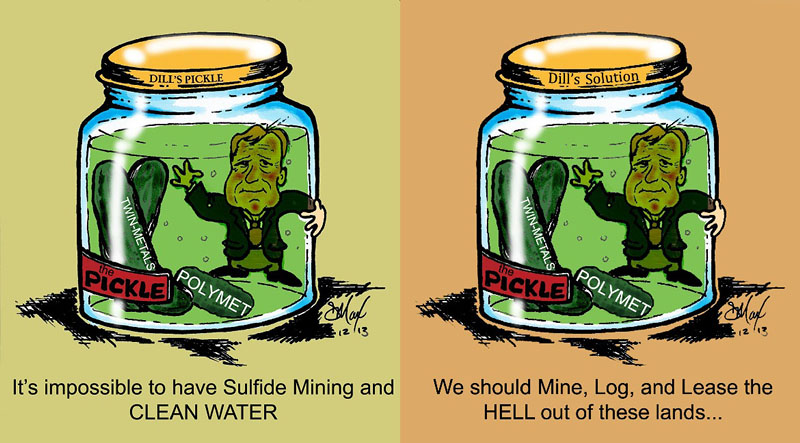 Dill’s Pickle & Solution  Environmentally, “We,re a spitten mess!” In 2002, Bob Cary spoke at Vermilion Community College. He was one of about 20 speakers in a series called “Speaking of Wilderness” sponsored by the Sigurd Olson Listening Point Foundation. Mining, fishing, canoeing, Knife Lake, local Native American elders, the Ojibwa language (which he studied in his later years and could speak, as best a white man can), and what we are doing to the environment, were all covered. His conclusion that ‘We’re a spittin mess!” could only be argued against by a Tea Party Republican or an Iron Range Mining activist. What would Jackpine Bob Cary have to say about Sulfide Ore mining in the Arrowhead region of Minnesota. I doubt that it would be any different, “We’re a spittin mess.
Pamela Meyer, the author of LieSpotting, gave a talk at TED Talks giving us the tools to help spot when people are telling lies, which she believes is becoming an epidemic. She argues that honesty is a value worth preserving, that lying is always accompanied by some reation that is detectable, if we know what to look for. My opinion, that is very truth is very difficult to come by in Politics and Mining PR and learning to tell when we are being lied to is a valuable tool in our own preservation. We know what they are telling us. But, what is true and what is NOT.  Polymet-What are you going to do with the 99% waste? 500 years of clean up is incomprehensible to a normal person, but not to a mining company. There seems to be a severe disconnect with reality. We have fragmented forests, impaired waters, and epidemiological studies show our region is below average in health in a number of important indicators. We are looking for the maximum daily load of pollutants rather than looking at the very real possibility that we should just stop polluting our forests, waters and life, that no corporation has the right to pollute to the max when we don’t know the long term effects of the increasingly complex mix of chemicals in our environment and bodies. We humans are a noble lot when cleaning up our messes, mostly, and terribly ignorant about how to prevent the disasters in the first place. 500 years ago that didn’t matter, there was a LOT of room for error. In 500 years I assure you there will be ABSOLUTELY NO room for error. Where are we now? From the known health of the ocean, the air, the forests, and us, humans it might be fair to assume we are much closer to NOT MUCH room for error. So, we should be significantly more cautious than we have been even a few decades ago. It’s not the 1% Non-ferrous metals you’re taking that will be the problem, but what you leave behind, for how long, and at what risk and cost to those of us who live here. The one good thing, for me, that has come out of the intense scrutiny of the Non-Ferrous Mining proposals is that we now know that iron mining has a significantly more tainted history and has left us a lasting legacy of pollution that we should have dealt with a long time ago, but will have to get serious about cleaning up now. The myth of “Minnesota’s Strong Environmental Regualtions,” often tauted by Policians and Mining advocates alike is a PURE and ABSOLUTE MYTH! Doesn’t exit. Of course it is most definitely better than third world countries, but that bar is so low as to be ludicrous. What ever level of Regulations we do have in Minnesota, don’t mean a darn thing when, once permitted, a mining company just applies for a VARIANCE with the MPCA. How often are variances granted, NEARLY EVERY TIME. And, even though these variances are supposed to be temporary, our agencies continue, time and again, to renew them. Not what a reasonable person would call STRONG REGULATIONS for protecting the environment. 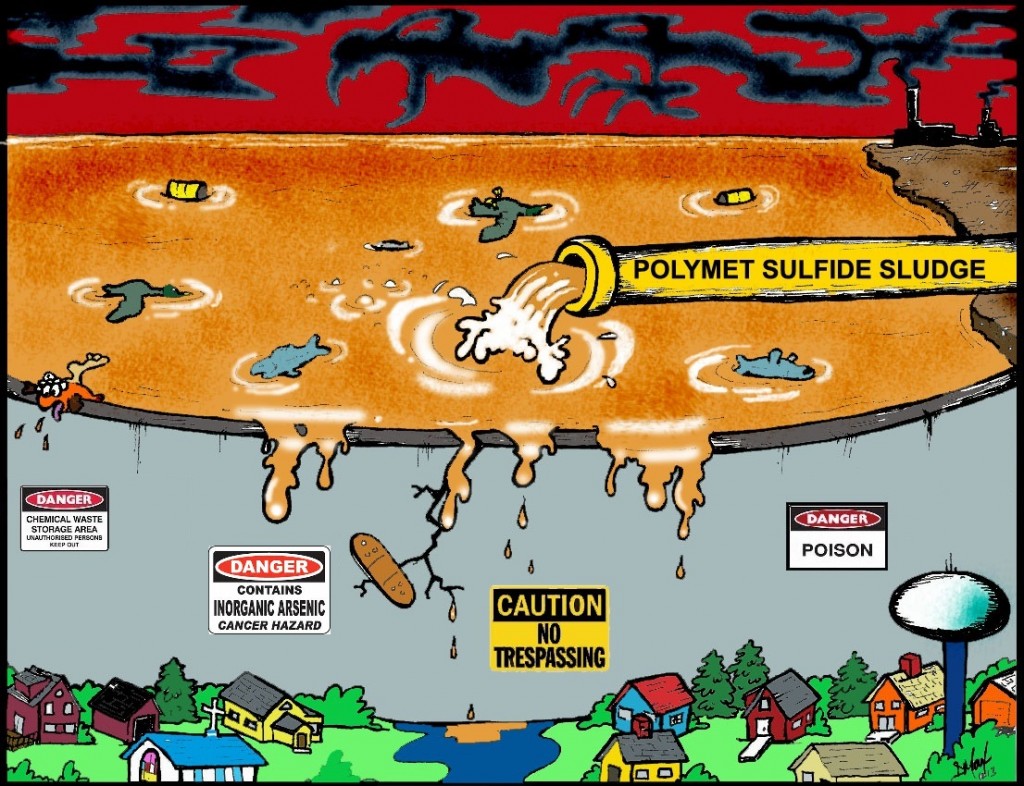 It’s the 99% we have to worry about. The problem isn’t what they want to take, the problem is what they are going to leave and how easy our politicians and so-called protection agencies make it for them, the mining companies to accumulate 20 years of toxic sludge in already leaking tailings ponds upstream from life.
 It’s the Laptop! View Video Here: Go Polymet Go! “Polymet says yes to some of life’s biggest questions.” (add your big questions you’d like Polymet to answer.) This Polymet/Glencore (Click here to see what Glencore is all about.) puff piece starts with an attractive surprised young blond looking down at a diamond ring. After 10 more brief idealized scenes with the sound track indicating Polymet want’s to be there and sounding hundreds of jobs and billions of dollars somewhat subliminally in the background to the final scene of the same attractive young blond throwing her arms around the neck of an attractive young boy and kissing him, to the sound track of “Polymet says yes to some of life’s biggest questions.” Video Story Board, scene by scene: 1. Surprised attractive blond, next frame diamond ring on her hand 2. Middle aged blond with doctor 3. Hybrid car with Fall Woods backdrop 4. Two clean workmen with hard hats in VERY clean mining equipment room 5. Sunrise over a meadow…maybe a production plant or city in the background 6. Hoyt Lakes clean colorful new-looking water tower 7. Closeup of person testing an electrical outlet 8. Ideal American female model reclining on a couch with laptop…this is as sexy as Polymet gets 9. Father and young daughter playing with a smart phone 10. Clean idealic welder in a large clean pipe 11. Young girl and boy frolicking on a playground 12. Finale: Attractive blond from scene one throwing her arms around attractive young boys neck and kissing him So, young people, when you are about to pop the big question, if your intended doesn’t say yes, Polymet will. However, if you have any other big questions for Polymet, you’ll just have to wait, they haven’t been real big on answering really important life’s questions. If you have a lot of money it’s easy to be superficially “image perfect” and appear to say something, while NOT. Oh yes Polymet, by all means, GO POLYMET GO! Life’s Big Questions for Polymet What is more important Health or Wealth? Will Glencore be financially responsible for any liabilities incurred in your copper mining efforts in Northeastern Minnesota? If you know how to “do it right” what has taken you so long? Failed DEIS in 2009, 2200 page modified DEIS today, why can’t you get that right? 2200 page DEIS and only 90 day citizen comment period? What are you hiding in all the paperwork? If R.O., reverse osmosis, is too difficult and costly for Mesabi Nugget in iron country what makes your R.O. so special in a larger volume situation and more chemically complex pollutant stream? Since you think you know “how to do it right this time”… Why haven’t you already done this successfully somewhere? Why don’t you propose a permitting situation where you will not ask for any variances, NONE, from the MPCA or EPA…ever during the life of mine? Why don’t you go to a third world county and prove yourself, then come back and mine in WI under the “We’ve Proven It First” banner? Please folks we are about to be bamboozled by the mining companies and their co-horts in government…ask your questions loudly and publicly. Send your questions for Polymet and we will make sure that Polymet, the DNR, the USFS, and our Congresspersons get copies. Thanks, we are making headway in shinning light on the severe problems with Sulfide Mining in our region. But, we must do more. The mining companies have extra money to throw at this and a lot of our taxpayer dollars are being used against the best interests of our region. Let your voice be heard somehow, somewhere.
 Maybe Babbitt’s Welcome Sign should read as above. This picture of the Babbitt Welcome sign area epitomizes the incorrigible nature of the “Mine, Log, and Lease the Hell Out of These Lands” crowd. They can not tolerate one dissenting vote without shouting “Dump Otto” from all the bully pulpits of Northeastern Minnesota. The statements made by the mayor of Babbitt at the Tuesday Group meeting in Ely where State Auditor Rebecca Otto spoke (11-26-2013) clearly show the good mayor still does not understand the difference between iron mining and sulfide mining. Anyone who is still locked in the “Jobs, Jobs, Jobs” mindset and is not asking the hard questions, as Rebecca Otto is doing, is only looking at benefits and ignoring the risks of sulfide mining. As auditor of the state of Minnesota, Otto is tasked with evaluating the costs and risks to the taxpayers of Minnesota. And, from the response of the overflowing crowd at Ely Tuesday Group, she is doing what she should be doing, doing it well, and we are thankful she is willing to shoulder the burdens of these hard questions. Most politicians in Minnesota are acting as if the numerous severe risks and potential costs to taxpayers are trivial. Otto is the first Minnesota state official to stand up and say we should have a long hard look at the cost to Minnesota taxpayers with non-ferrous (sulfide) mining. Click here to see the complete video of Rebecca Otto’s talk in Ely. For any conscientious individual, maybe one with a bit of critical thinking ability, Rebecca Otto’s stance is the ONLY logical and practical stance for a person with her responsibility and for the well being of Minnesota. The extreme mining reactionaries are so far from any truth on this matter they should be ashamed of themselves. However, shame is not an emotion they know and truth about mining is not something they even want to think about. I’ve only found them boldly confident in their “MINE THE HELL OUT OF THESE LANDS” position. The above sign should read…KEEP OTTO –DUMP POLYMET!!! We proudly support Rebecca Otto and have Otto bumper stickers, remittance envelopes for contributions, and literature. If after viewing her position in the video link above and you would like to support her also, please go to this page to contact her or support her as a volunteer or with an online donation http://www.rebeccaotto.com/contact.html
View Presentation by Bill Carter author of “Boom, Bust, Boom” In a speech to an overflowing crowd at Vermilion Community College in Ely, Minn., author and filmmaker Bill Carter talked about copper mining and the copper industry around the world. He talked about what he learned in doing research for his book “Boom, Bust, Boom” and his concern for his family and friends in Bisbee, Ariz., and Bristol Bay, Alaska. He concluded, due to the always-present extremely large piles of hazardous waste material generated by copper mining, there are some places where copper mining absolutely should not be done. Bristol Bay in Alaska and the Arrowhead Region of Northeastern Minnesota are two such places. It is too late for Bisbee, Ariz. and numerous other historical copper mining districts as the permanent damage to the land and water has already been done. In this presentation he covers every sales pitch given by past and present copper mining employees, CEOs, and pitchmen, and with historical evidence refutes them all one by one. Bill Carter, at a young age, has seen more of the world than most of us ever will and has experienced more of man’s political folly than most of us would want to see, let alone experience. “Boom, Bust ,Boom” is Bill Carter’s third book. To fully appreciate “Boom, Bust, Boom,” I recommend reading his other two books, “Fools Rush In” and “Red Summer,” in that order, the order in which he wrote them. He is learning and defining himself in each adventure, which he shares through his writings and talks. Because he is obviously caring and non-judgmental about the people involved, on both sides, he is able to come to a more reasoned conclusion than those of us who are emotionally invested in one outcome or the other. He points out that we must come to grips with the fact that we all need and use a LOT of copper. That fact is undeniable. It is also undeniable that copper mining results is a massive quantity of hazardous waste material to deal with ALWAYS. It is also undeniable that mining companies have NEVER properly dealt with the hazardous waste of copper mining. The logical conclusion is that copper mining should NOT be done in certain places. It is my personal view that, along with Bristol Bay, Alaska, the Arrowhead Region of Northeastern Minnesota — including the Rainy River Watershed, the Lake Superior Watershed and the Boundary Waters Canoe Area Wilderness — is one of those NO COPPER MINING places.
In Ely there is a schism, caused by filiopietism *, but Elyites tell mining jobs are the sell and NO to clean water environmentalism! * “the tragic circle”
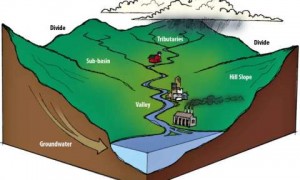
After Hurricane Sandy swept through the northeast of the United States late October 2012, millions of New Yorkers were left for days without electricity. But they still had access to drinking water, thanks to New York City’s reliance on protected watershed areas for potable water. Instead of using electric-powered water treatment plans, New York City brings its high-quality drinking water through aqueducts connected to protected areas in the nearby Catskill/Delaware forests and wetlands – just one example of how protecting watersheds can provide residential areas with drinking water and flood and pollution protection at bargain basement prices. New York saved between four and six billion dollars on the cost of water treatment plants by protecting forests and compensating farmers in the Catskills for reducing pollution in lakes and streams. “Whether you need to save water-starved China from economic ruin or protect drinking water for New York City, investing in natural resources is emerging as the most cost-efficient and effective way to secure clean water and recharge our dangerously depleted streams and aquifers,” said Michael Jenkins, president of Forest Trends, a non-governmental organization (NGO) in the United States, which compiled the report. Previous studies have shown that pollution, the building of dams, agricultural runoff, conversion of wetlands, and waterworks engineering have severely affected global river systems. The wealthier the country, the bigger the threat to river systems, primarily because of expensive waterworks engineering, according to the first-ever health assessment of river ecosystems around the world, as previously reported by IPS.Promoting a new approach But trees, grasses and plants are extremely effective at cleaning and retaining water, as well as reducing sedimentation that clogs water reservoirs, Bennett told IPS. “The benefits from these watershed programs extend far beyond water: they support biodiversity, reduce greenhouse gas emissions, and provide income for the rural poor,” she said. In watershed protection programs such as those in New York, farmers are paid to use soil and water conservation techniques – payment for good stewardship that benefits the public, Bennett added. Government regulations, however, remain a major constraint to similar projects in many countries. New York’s well documented and highly successful strategy has not been emulated by many other cities, including those in China or India, where engineering expertise is highly prized and huge engineering works are a matter of national pride. China is one country that has begun to change its approach, according to the report. About 108,000 residents in struggling communities upstream of the southern coastal city of Zhuhai are receiving new health insurance benefits in exchange for adopting land management practices to improve drinking water in the region. “There are lots of different ways watershed investments are being made in China, some good and some bad. There’s lots of learning happening,” said Bennett. Beginning of change In Latin America, the trend in water programs is to offer compensation other than cash for protecting water resources. In Bolivia’s Santa Cruz valley, for example, more than 500 families receive beehives, fruit plants and wire, which can be used for fencing to keep livestock away from rivers and stream banks, in return for their water protection efforts. The vast majority of investments in watersheds are with public money. The private sector still thinks providing good quality water is up to governments, Bennett said. However, the public sector is unlikely to be able to invest the 17.7 trillion dollars needed for water infrastructure by 2030, according to the Organization for Economic Cooperation and Development (OECD). |
||||||
|
Copyright © 2026 Ely Minnesota - All Rights Reserved Powered by WordPress & Atahualpa |
||||||


 (Published: Saturday 19 January 2013 in Nation of Change)